
What you need to know
A recommendation is more helpful when you describe what you enjoy: strong or mild coffee, black or milk-based drinks, sweet or less sweet flavours. Useful questions are "What would you recommend if I like mild coffee?" and "Could I try a smaller size?".
Understand the Australian context
Coffee flavour descriptions are subjective. A barista may suggest a house blend, a single origin or a filter coffee, depending on what you like. You get a better suggestion when you give two or three clues.
Useful clues are: milk or black, strong or mild, smooth or fruity, and how big a drink you want. You can also ask what beans the café is using today, or whether the café can offer a small sample.
If you try a drink and do not enjoy it, you can say so politely: "It was not quite to my taste, but thank you". Baristas use that feedback to suggest something else next time.
Key words and phrases
- recommend
- Suggest something good for you.
- preference
- What you like.
- mild
- Gentle in taste.
- smooth
- Easy to drink, not harsh.
- chocolatey
- Tasting like chocolate or cocoa.
- house blend
- The café's regular coffee blend.
- sample
- A small taste before you order.
- to my taste
- Matching what I like.
Conversation practice: choosing a coffee with help
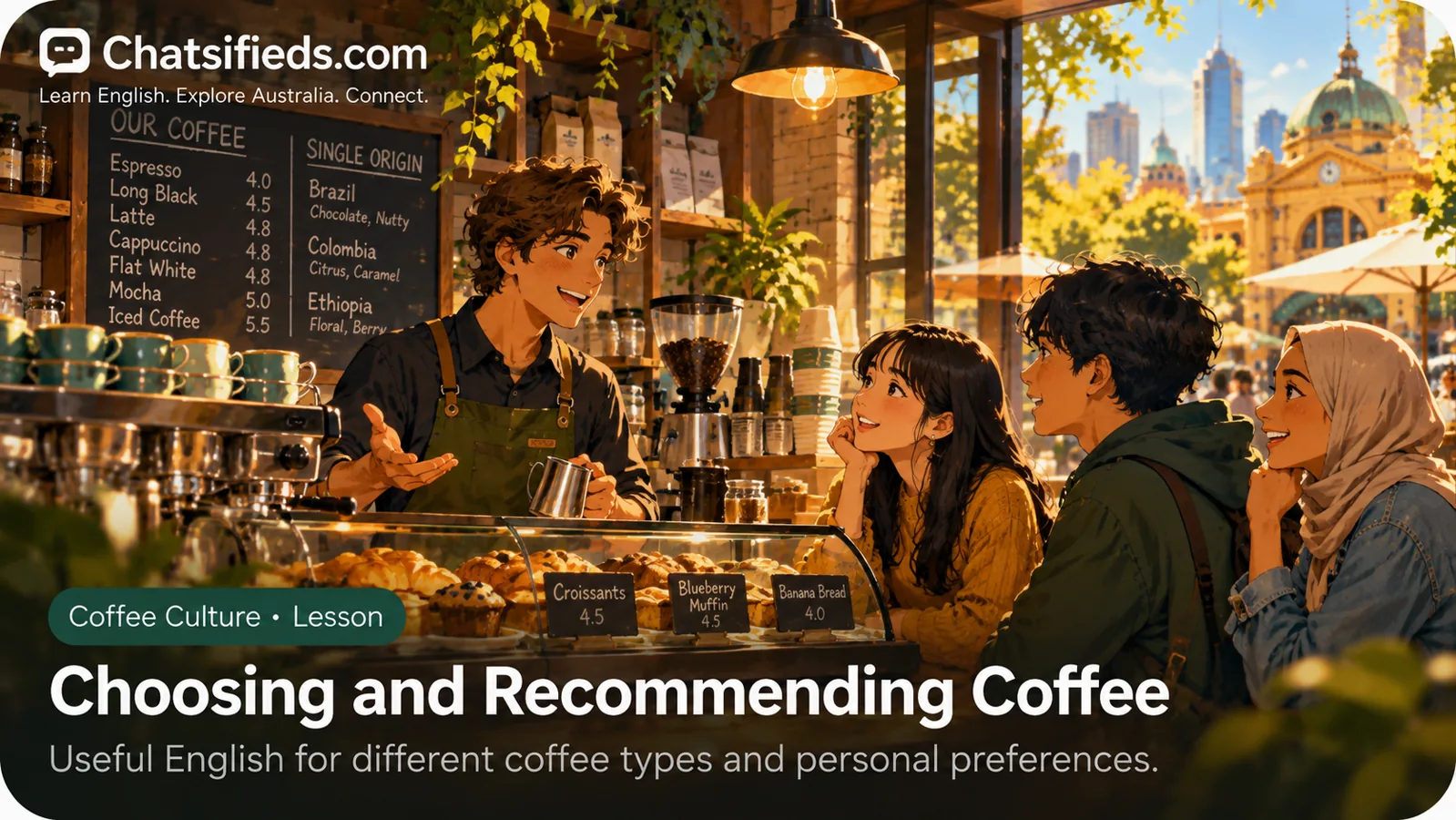
Customer: Hi. I am not sure what to order. Could you help me choose?
Barista: Of course. Do you usually drink coffee with milk or black?
Customer: Usually with milk. I like something smooth, not too bitter.
Barista: Then a latte or a flat white might suit you. Do you like a stronger or milder taste?
Customer: Milder, I think. Can I ask what beans you are using today?
Barista: Sure. We have a medium roast blend, and there is also a single origin on filter.
Customer: Is the blend sweet or fruity? I do not mind a little sweetness.
Barista: It has a nutty, caramel kind of taste. Many people find it gentle.
Customer: That sounds good. Could I get a small size, please?
Barista: No problem. A small latte coming up.
Customer: Thanks. Actually, could I try a little taste of the filter first?
Barista: Of course. Here is a small sample. Let me know what you think.
- The barista asks two simple questions (milk or black, strong or mild) to narrow the choice.
- "Could I try a little taste?" is polite. Not every café can offer a sample.
- "Many people find it gentle" is a soft way to describe a taste without saying it is right for everyone.
More useful phrases
- What would you recommend if I like mild coffee?
- Which coffee suits a mild taste?Use it: Give one clue and ask.
- Could you help me choose?
- Please help me decide.Use it: A friendly way to start.
- I like something smooth, not too bitter.
- My taste is smooth and mild.Use it: Describe your preference.
- Is it more chocolatey or fruity?
- Which taste is stronger?Use it: Ask about flavour.
- What roast is this?
- How dark is the roast?Use it: Ask about the beans.
- Could I have a smaller size, please?
- I would like a small cup.Use it: Try a new drink without ordering a lot.
- Could I try a little taste first?
- May I taste a sample?Use it: Ask politely. The café may say no.
- It was not quite to my taste, but thank you.
- I did not enjoy it, but I appreciate your help.Use it: A polite way to give feedback.
- Sorry, could you say that again?
- Please repeat what you said.Use it: Use this when you miss a word.
Say it in a real conversation
Use these sentences in a real conversation. The replies you hear will change from place to place.
| When | You can say | It means |
|---|---|---|
| Give one clue and ask. | What would you recommend if I like mild coffee? | Which coffee suits a mild taste? |
| A friendly way to start. | Could you help me choose? | Please help me decide. |
| Describe your preference. | I like something smooth, not too bitter. | My taste is smooth and mild. |
| Ask about flavour. | Is it more chocolatey or fruity? | Which taste is stronger? |
| Ask about the beans. | What roast is this? | How dark is the roast? |
| Try a new drink without ordering a lot. | Could I have a smaller size, please? | I would like a small cup. |
Listen for the key words in the reply and answer in a short, clear sentence.
Say it aloud: give one clue and ask
Saying a sentence out loud before you need it makes real conversations easier. Accents differ, so aim to be clear, not perfect.
- Slow. Read the sentence slowly, one phrase at a time.
- In full. Say: What would you recommend if I like mild coffee?
- At normal speed. Say it again, as you would in a real conversation.
- Listen. Listen for the key words in the reply.
Practice 1: Role-play with a partner
Situation: You are not sure what to order. Describe your taste and ask the barista to recommend a coffee.
Work with a friend, a classmate or your mirror. One person is the barista. The other is customer. Read the lines, then cover the “You could say” answers and try it from memory. Swap roles.
barista: “Hi, how can I help?”
You could say:
- “Hi. I am not sure what to order. Could you help me choose?”
- “Could you help me choose?”
barista: “Of course. Do you usually drink coffee with milk or black?”
You could say:
- “Usually with milk. I like something smooth, not too bitter.”
- “I like something smooth, not too bitter.”
barista: “Then a latte or a flat white might suit you. Do you like a stronger or milder taste?”
You could say:
- “Milder, I think. Can I ask what beans you are using today?”
- “What would you recommend if I like mild coffee?”
barista: “Sure. We have a medium roast blend, and there is also a single origin on filter.”
You could say:
- “Is the blend sweet or fruity? I do not mind a little sweetness.”
- “Is it more chocolatey or fruity?”
Challenge: Do the conversation again without looking at the lines, and change one detail.
Practice 2: Fill the gap
Say the missing word or phrase out loud before you open the answer.
What would you ___ if I like mild coffee?
Show answer
recommend — The phrase means: Which coffee suits a mild taste?
Could you help me ___?
Show answer
choose — The phrase means: Please help me decide.
I like ___ smooth, not too bitter.
Show answer
something — The phrase means: My taste is smooth and mild.
Is it more ___ or fruity?
Show answer
chocolatey — The phrase means: Which taste is stronger?
What ___ is this?
Show answer
roast — The phrase means: How dark is the roast?
Could I have a ___ size, please?
Show answer
smaller — The phrase means: I would like a small cup.
Common mistakes and better ways to say it
Less helpful: “Give me the best coffee.”
Try instead: “I like something smooth and not too bitter. What would you recommend?”
"Best" depends on taste. A clue helps the barista.
Less helpful: “Make it normal.”
Try instead: “Could I get a regular flat white?”
"Normal" is unclear. Name the drink and the size.
Less helpful: “This is terrible.”
Try instead: “It was not quite to my taste, but thank you.”
A polite comment is kinder and gives the barista useful information.
Less helpful: “Ordering a large drink to try something new.”
Try instead: “Could I have a smaller size, please?”
A small size lets you try a new drink without wasting coffee.
Taste kindly
Australian baristas usually like to help customers find a drink they enjoy. Describing your taste is a normal part of the conversation and does not need expert words.
Say what you noticed, for example "a bit too strong for me", then ask if there is something milder. That is honest and polite.
Advertisement
Real-life mission
Practise asking for a recommendation.
You do not need to buy anything. Saying the sentences aloud is good practice.
Phrase Wall practice: phrases to own
Open a phrase to see it on the Phrase Wall, practise it, and save it to My Learning.
- “What would you recommend if I like mild coffee?”Which coffee suits a mild taste?
- “Could you help me choose?”Please help me decide.
- “I like something smooth, not too bitter.”My taste is smooth and mild.