
What you need to know
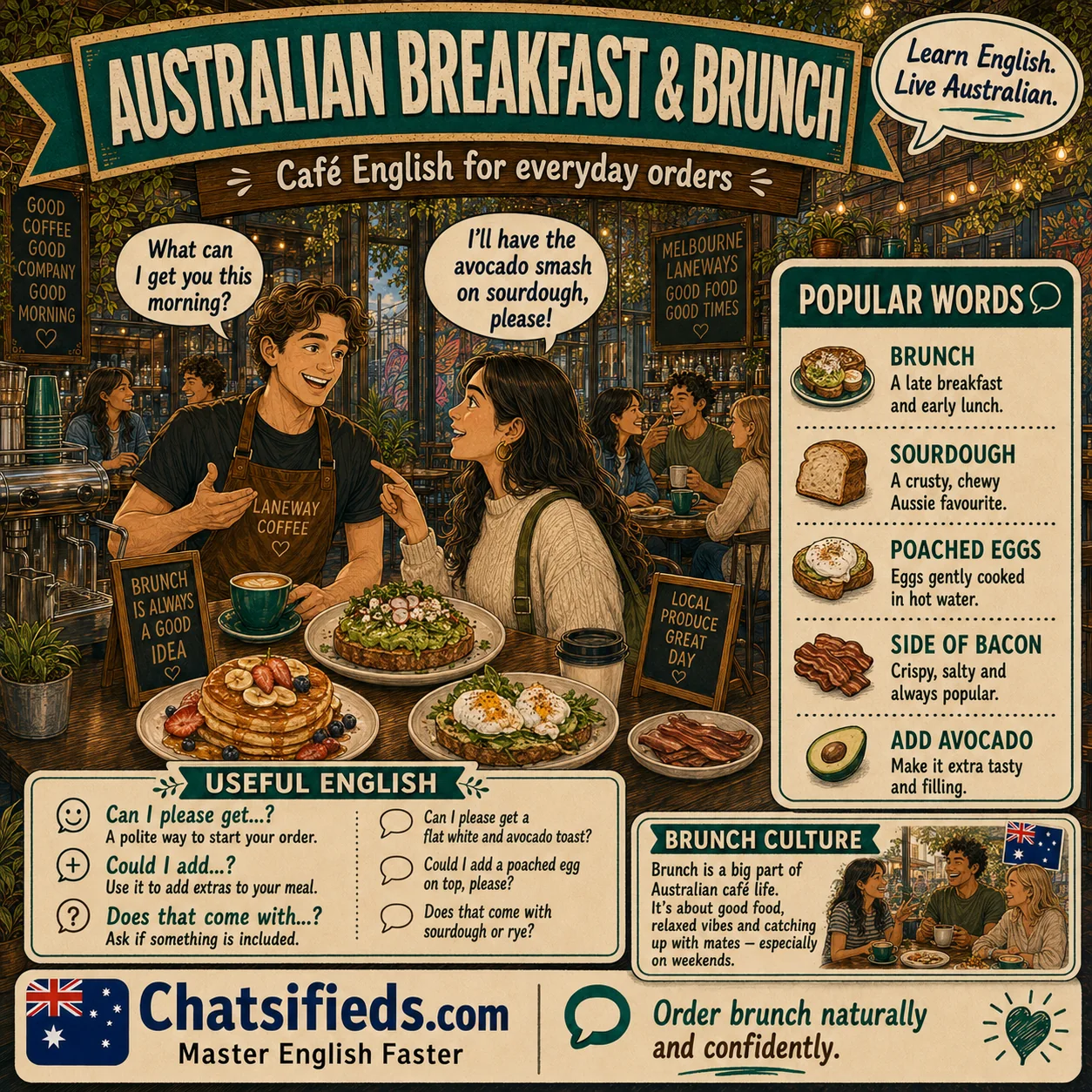
Brekkie is informal Australian English for breakfast. Brunch is a later meal that combines breakfast and lunch, often a social outing. Breakfast ordering adds new questions: How would you like your eggs? Which bread? Any sides? Warmed up?
Understand the Australian context
Australian café English often mixes coffee ordering with breakfast and brunch vocabulary. Many cafés serve food as well as coffee, so you may need to answer questions about eggs, bread and extras before you pay.
The Macquarie Dictionary treats brekkie, breaky and breakie as informal spellings for breakfast. You will see brekkie on menus and hear it in speech, but you can always say breakfast.
Food ordering creates follow-up questions: How would you like your eggs? Which bread? Any sides? Would you like that toasted? These questions are easier when you learn them as part of one café conversation.
Key words and phrases
- breakfast
- The first meal of the day.
- brekkie
- An informal Australian word for breakfast.
- brunch
- A later meal that combines breakfast and lunch.
- smashed avo
- Smashed avocado, usually served on toast.
- side
- An optional extra food item added to the meal.
- poached
- Eggs cooked gently in hot water.
- scrambled
- Eggs mixed and cooked in a pan.
- sourdough
- A type of bread with a slightly sour taste.
- warmed up
- Heated before serving.
Conversation practice: ordering breakfast and a coffee
Student: Could I get the smashed avo with two poached eggs, please?
Waiter: Sure. Any sides?
Student: No thanks. And a regular flat white.
Waiter: Full cream milk?
Student: Yes, thanks.
Waiter: White, wholemeal or sourdough?
Student: Sourdough, please.
Waiter: Great. Here or takeaway?
Student: To have here, thanks.
Waiter: Is that everything?
Student: Yes, that is all.
Waiter: No worries. Take a seat and we will bring it over.
- "Any sides?" asks whether you want optional extras. "No thanks" is a polite answer.
- "White, wholemeal or sourdough?" asks which bread. Choose one of the three.
- Food and drink can be ordered in one sentence group. You do not have to order them separately.
More useful phrases
- Could I get the smashed avo with two poached eggs, please?
- I would like the smashed avocado with two poached eggs.Use it: A full breakfast order.
- Are you still serving breakfast?
- Is breakfast still available?Use it: Ask this late in the morning.
- Could I add a side of bacon?
- I would like bacon as an extra.Use it: Ask this to add an extra item.
- Sourdough, please.
- I would like sourdough bread.Use it: Answer to the bread question.
- Poached, please.
- I would like poached eggs.Use it: Answer to "How would you like your eggs?".
- Could you warm that up, please?
- Please heat it.Use it: Ask this for a cabinet item.
- What do you recommend for brekkie?
- What breakfast should I order?Use it: A friendly way to ask for help.
- To have here, thanks.
- I will eat it in the café.Use it: Answer to "Here or takeaway?".
- Could I get that with a flat white, please?
- I would like a flat white as well.Use it: Add a coffee to the order.
Say it in a real conversation
Use these sentences in a real conversation. The replies you hear will change from place to place.
| When | You can say | It means |
|---|---|---|
| A full breakfast order. | Could I get the smashed avo with two poached eggs, please? | I would like the smashed avocado with two poached eggs. |
| Ask this late in the morning. | Are you still serving breakfast? | Is breakfast still available? |
| Ask this to add an extra item. | Could I add a side of bacon? | I would like bacon as an extra. |
| Answer to the bread question. | Sourdough, please. | I would like sourdough bread. |
| Answer to "How would you like your eggs?". | Poached, please. | I would like poached eggs. |
| Ask this for a cabinet item. | Could you warm that up, please? | Please heat it. |
Listen for the key words in the reply and answer in a short, clear sentence.
Useful words at a glance
| Word | What it means | What you might say |
|---|---|---|
| Breakfast | The meal. | “Are you still serving breakfast?” |
| Brekkie | An informal Australian nickname for breakfast. | Often seen on menus and heard in speech. |
| Brunch | A later meal that combines breakfast and lunch, often a social outing. | Often a social outing with friends. |
| Side | An optional extra food item added to the meal. | “Could I add a side of bacon?” |
What you might hear
“How would you like your eggs?”
Choose a cooking style such as poached, scrambled or fried.
“Any sides?”
Choose optional extras if you want them.
“White, wholemeal or sourdough?”
Choose the bread type.
“Warmed up?”
Say whether you want the item heated.
Say it aloud: a full breakfast order
Saying a sentence out loud before you need it makes real conversations easier. Accents differ, so aim to be clear, not perfect.
- Slow. Read the sentence slowly, one phrase at a time.
- In full. Say: Could I get the smashed avo with two poached eggs, please?
- At normal speed. Say it again, as you would in a real conversation.
- Listen. Listen for the key words in the reply.
Practice 1: Role-play with a partner
Situation: You are ordering breakfast and a coffee. Answer the waiter's questions about eggs, bread and sides.
Work with a friend, a classmate or your mirror. One person is the waiter. The other is student. Read the lines, then cover the “You could say” answers and try it from memory. Swap roles.
waiter: “Hi, how can I help?”
You could say:
- “Could I get the smashed avo with two poached eggs, please?”
- “Could I add a side of bacon?”
waiter: “Sure. Any sides?”
You could say:
- “No thanks. And a regular flat white.”
- “Could I get that with a flat white, please?”
waiter: “Full cream milk?”
You could say:
- “Yes, thanks.”
- “To have here, thanks.”
waiter: “White, wholemeal or sourdough?”
You could say:
- “Sourdough, please.”
- “Could I get the smashed avo with two poached eggs, please?”
Challenge: Do the conversation again without looking at the lines, and change one detail.
Practice 2: Fill the gap
Say the missing word or phrase out loud before you open the answer.
Could I get the smashed avo with two ___ eggs, please?
Show answer
poached — The phrase means: I would like the smashed avocado with two poached eggs.
Are you still serving ___?
Show answer
breakfast — The phrase means: Is breakfast still available?
Could I add a side of ___?
Show answer
bacon — The phrase means: I would like bacon as an extra.
What do you ___ for brekkie?
Show answer
recommend — The phrase means: What breakfast should I order?
Could I get that with a flat ___, please?
Show answer
white — The phrase means: I would like a flat white as well.
The first meal of the day. The word is ___.
Show answer
breakfast — "breakfast": The first meal of the day.
Common mistakes and better ways to say it
Less helpful: “A brunch of mushrooms, please.”
Try instead: “Could I add a side of mushrooms, please?”
A side is an extra food item. Brunch is a meal.
Less helpful: “Eggs, please.”
Try instead: “Poached eggs, please.”
Staff will ask how you want them, so say it first to save time.
Less helpful: “Bread white.”
Try instead: “White, please.”
Short answers are fine, but a normal word order sounds more natural.
Less helpful: “Is breakfast only in the morning?”
Try instead: “Are you still serving breakfast?”
The second question is the usual way to ask at the counter.
Breakfast out is a habit
Eating breakfast or brunch at a café is a popular habit in many Australian cities, often with friends or family. Menus may include eggs, avocado toast and sweet dishes, and many cafés serve all-day breakfast.
Because orders have several parts, staff ask short questions in a regular order: eggs, bread, sides, then drinks. If you learn the order of the questions, you can answer quickly.
Advertisement
Real-life mission
Practise a breakfast order.
You do not need to buy anything. Saying the sentences aloud is good practice.
Phrase Wall practice: phrases to own
Open a phrase to see it on the Phrase Wall, practise it, and save it to My Learning.
- “Are you still serving breakfast?”Is breakfast still available?
- “Could I get the smashed avo with two poached eggs, please?”I would like the smashed avocado with two poached eggs.
- “Could I add a side of bacon?”I would like bacon as an extra.