
What you need to know
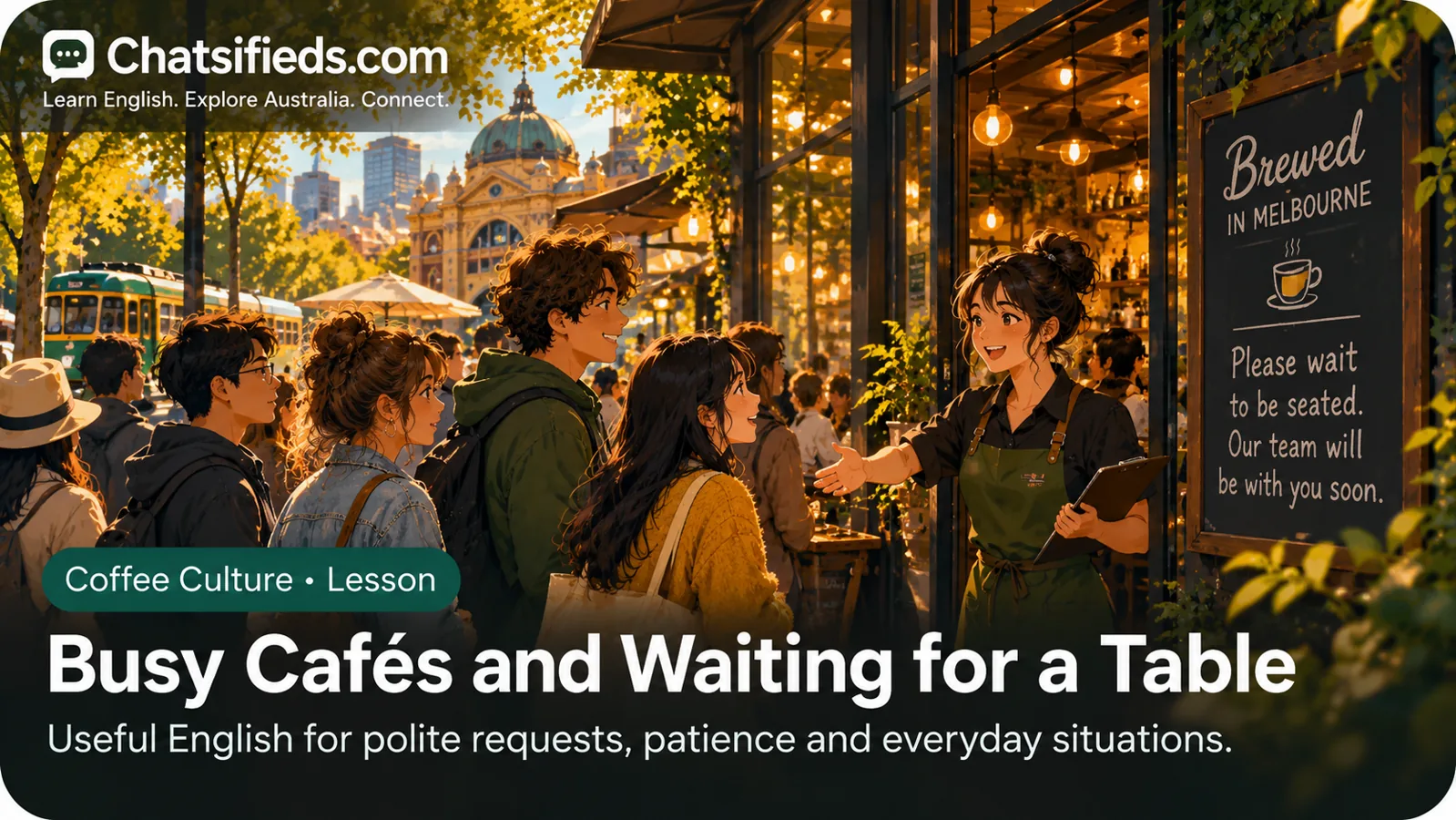
Some cafés seat you, some use counter service and a table number, and a busy café may change how it works. Look for signs at the entrance and ask staff. When the café is full, ask roughly how long the wait is, without demanding an exact promise.
Understand the Australian context
Cafés work in different ways. At some, staff seat you and take your order at the table. At others, you order and pay at the counter, then take a table number or find a seat. Signs near the door or counter often explain the system, and a short question is welcome.
When a café is busy, staff are doing several jobs at once. Use a calm voice, wait for a good moment and ask clearly. "Roughly how long do you think the wait might be?" is kinder than "Tell me exactly".
If you do not want to wait, "Thanks, we will try somewhere else" is polite and clear. If an order feels slow, wait for a quiet moment and mention your table number or name.
Key words and phrases
- table for two
- A table for two people.
- wait
- Time before you are seated or served.
- put our names down
- Add our names to the waiting list.
- waitlist
- A list of people waiting for a table.
- booking
- A reserved table.
- walk-in
- A customer without a booking.
- table number
- A number placed on your table.
- share a table
- Sit at a table with other people.
Conversation practice: arriving at a busy café
Customer: Hi, is there a table for two?
Staff: We are quite busy. There is about a twenty-minute wait.
Customer: Thanks. Can we put our names down?
Staff: Yes. May I have a name, please?
Customer: It is Sam. Do I need to wait to be seated, or can we choose a table?
Staff: Good question. Please wait here and I will check for you.
Customer: Thank you. Do you know roughly how long it might be?
Staff: Probably about fifteen minutes, but it can change.
Customer: That is fine. Is it okay if we wait outside?
Staff: Of course. I will call your name when a table is ready.
Customer: Can we look at the menu while we wait?
Staff: Sure, here you go. You can order at the counter once you are seated.
- "Roughly how long" asks for an estimate, not a promise.
- "Put our names down" means add your names to the list.
- The staff member explains the system: wait, then order at the counter.
More useful phrases
- Is there a table for two?
- Do you have space for two people?Use it: Ask about tables.
- Can we put our names down?
- Can we join the list?Use it: Join the waitlist.
- Do I need to wait to be seated?
- May we choose a table?Use it: Check the system.
- Roughly how long do you think the wait might be?
- About how many minutes?Use it: Ask without demanding.
- Is it okay if we wait outside?
- May we wait outside?Use it: Ask permission.
- I have a booking under Lee.
- I reserved a table.Use it: Say you have a booking.
- Do we order at the counter or at the table?
- How does ordering work?Use it: Check the system.
- Thanks, we will try somewhere else.
- We cannot wait.Use it: Leave politely.
- Thanks, have a good one.
- Thank you, and I hope your day goes well.Use it: A friendly way to finish.
Say it in a real conversation
Use these sentences in a real conversation. The replies you hear will change from place to place.
| When | You can say | It means |
|---|---|---|
| Ask about tables. | Is there a table for two? | Do you have space for two people? |
| Join the waitlist. | Can we put our names down? | Can we join the list? |
| Check the system. | Do I need to wait to be seated? | May we choose a table? |
| Ask without demanding. | Roughly how long do you think the wait might be? | About how many minutes? |
| Ask permission. | Is it okay if we wait outside? | May we wait outside? |
| Say you have a booking. | I have a booking under Lee. | I reserved a table. |
Listen for the key words in the reply and answer in a short, clear sentence.
Say it aloud: ask about tables
Saying a sentence out loud before you need it makes real conversations easier. Accents differ, so aim to be clear, not perfect.
- Slow. Read the sentence slowly, one phrase at a time.
- In full. Say: Is there a table for two?
- At normal speed. Say it again, as you would in a real conversation.
- Listen. Listen for the key words in the reply.
Practice 1: Role-play with a partner
Situation: You arrive at a busy café with a friend. Ask about a table, the wait and how ordering works.
Work with a friend, a classmate or your mirror. One person is the staff. The other is customer. Read the lines, then cover the “You could say” answers and try it from memory. Swap roles.
staff: “Hi, how can I help?”
You could say:
- “Hi, is there a table for two?”
- “Is there a table for two?”
staff: “We are quite busy. There is about a twenty-minute wait.”
You could say:
- “Thanks. Can we put our names down?”
- “Can we put our names down?”
staff: “Yes. May I have a name, please?”
You could say:
- “It is Sam. Do I need to wait to be seated, or can we choose a table?”
- “Do I need to wait to be seated?”
staff: “Good question. Please wait here and I will check for you.”
You could say:
- “Thank you. Do you know roughly how long it might be?”
- “Roughly how long do you think the wait might be?”
Challenge: Do the conversation again without looking at the lines, and change one detail.
Practice 2: Fill the gap
Say the missing word or phrase out loud before you open the answer.
Is there a ___ for two?
Show answer
table — The phrase means: Do you have space for two people?
Can we put our ___ down?
Show answer
names — The phrase means: Can we join the list?
Do I need to wait to be ___?
Show answer
seated — The phrase means: May we choose a table?
Roughly how long do you think the wait ___ be?
Show answer
might — The phrase means: About how many minutes?
Is it okay if we wait ___?
Show answer
outside — The phrase means: May we wait outside?
I have a ___ under Lee.
Show answer
booking — The phrase means: I reserved a table.
Common mistakes and better ways to say it
Less helpful: “How long? Tell me exactly.”
Try instead: “Roughly how long do you think the wait might be?”
Staff cannot promise an exact time.
Less helpful: “Sitting down without asking.”
Try instead: “Do I need to wait to be seated?”
Systems differ.
Less helpful: “Where is my coffee? (when you mean the wait)”
Try instead: “Sorry to bother you, could you check on our order?”
Mention your table number or name.
Less helpful: “Walking out silently.”
Try instead: “Thanks, we will try somewhere else.”
A polite goodbye is clearer.
Reading the room
Busy Australian cafés often combine several systems at once, so signs help. If you are unsure, a short question to a staff member is welcome.
Keep your voice calm and your question short. Staff are doing several jobs at once.
Advertisement
Real-life mission
Read the room.
You do not need to buy anything. Saying the sentences aloud is good practice.
Phrase Wall practice: phrases to own
Open a phrase to see it on the Phrase Wall, practise it, and save it to My Learning.
- “Roughly how long might the wait be?”Do you have space for two people?
- “Is there a table for two?”Do you have space for two people?
- “Can we put our names down?”Can we join the list?