
What you need to know
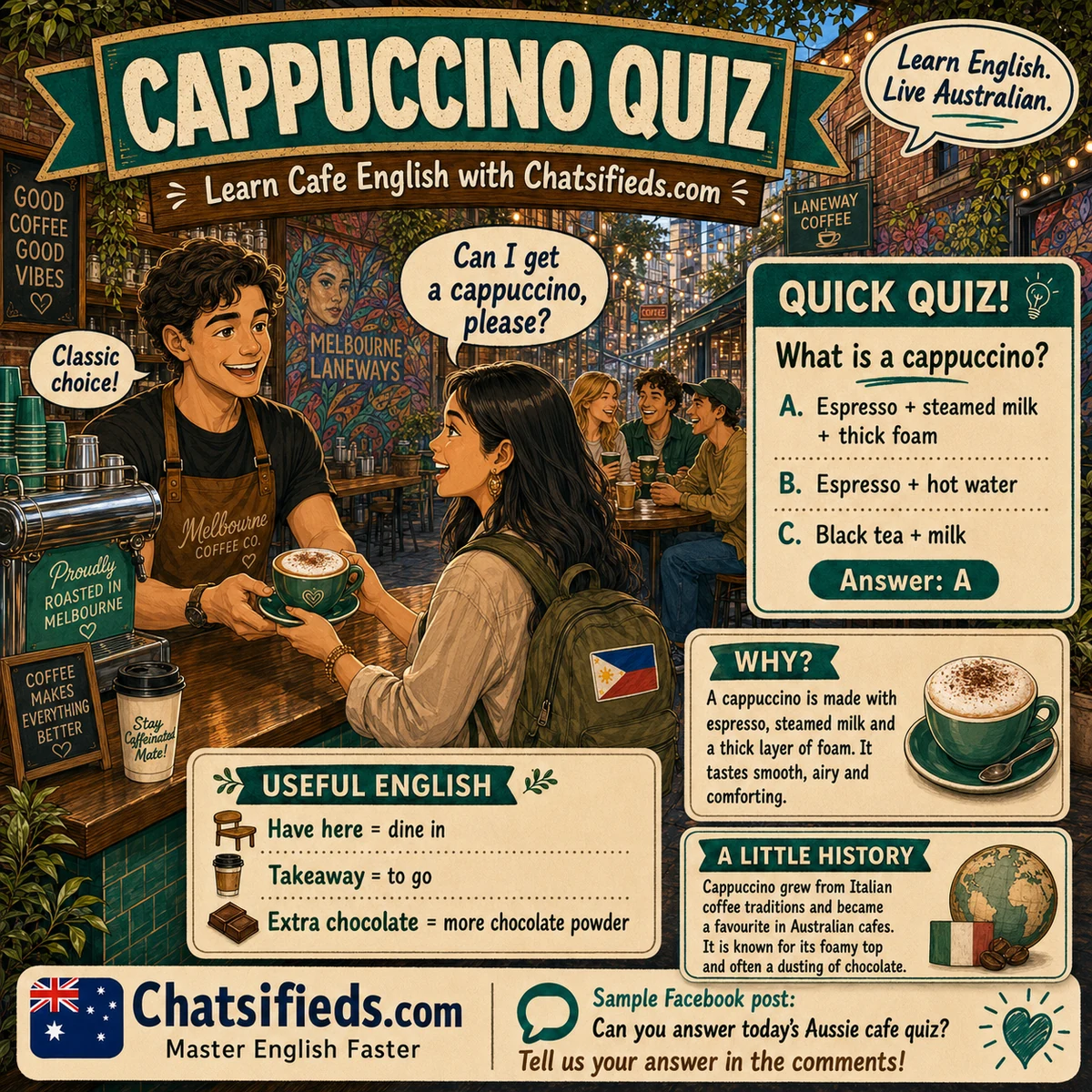
A cappuccino is an espresso coffee with steamed milk, a thicker layer of foam, and often chocolate powder on top in Australian cafés.
Understand the Australian context
Cappuccinos are common in Australian cafés, especially in busy city coffee scenes. This drink helps English learners practise milk vocabulary, polite requests, service choices and friendly café small talk.
A cappuccino is an espresso coffee with steamed milk, foam and usually chocolate powder on top in Australian cafés. It is a familiar order for learners who like a balanced coffee with a foamy top.
A cappuccino has a thicker layer of foam than a latte or flat white, so the top feels light and airy. In many Australian cafés it also arrives with chocolate powder on top, so say so if you would prefer it plain.
A good sentence to practise is: “Can I please get a cappuccino?” This sounds polite, clear and natural at the counter. You can add “to take away”, “to have here”, “with oat milk”, “regular”, “large”, or “extra hot” after the drink name.
Key words and phrases
- chocolate powder
- The brown powder many Australian cafés sprinkle on top of a cappuccino.
- thick foam
- A deeper layer of milk bubbles than on a flat white or latte.
- balanced
- Not too strong and not too milky.
- Can I grab...?
- A casual way to order. “Can I grab a latte?” means “Can I have a latte?”
- No worries
- A friendly Australian reply. It can mean “that's okay”, “sure”, or “you're welcome”.
- Takeaway
- Coffee you carry with you. In Australia this is more common than saying “to go”.
- Cheers
- A casual “thanks”. Students can still use “thank you” if they want to sound more formal.
- flat white
- Espresso + steamed milk + thin microfoam.
- long black
- Espresso poured over hot water.
- latte
- Espresso with more steamed milk and a light layer of foam.
Conversation practice: ordering a cappuccino
Customer: Hi, Could I get a cappuccino, please?
Barista: Sure. Would you like it regular or large?
Customer: Regular, thanks.
Barista: Here or takeaway?
Customer: Takeaway, thanks.
Barista: No worries. What name was that?
Customer: Paul. Thanks!
Barista: Cash or card?
Customer: Card, thanks.
Barista: Great. It will be a couple of minutes.
Customer: No worries. Cheers!
Barista: Have a good one.
- "Can I grab...?" and "Could I get...?" are both friendly ways to order. Add "please" or "thanks".
- "Takeaway" means you will carry the drink away. "Here" means you will stay in the café.
- "No worries" is a very common reply. It can mean "that is fine" or "sure".
More useful phrases
- Can I please get a cappuccino?
- I would like a cappuccino.Use it: A polite order using "please get".
- Could I get a cappuccino, no chocolate, please?
- A cappuccino without chocolate powder on top.Use it: Say this if you do not want chocolate powder.
- Could I get a cappuccino to take away?
- I would like a cappuccino in a cup to carry.Use it: Say this if you are not staying in the café.
- To have here, thanks.
- I will drink it inside the café.Use it: Answer to "Here or takeaway?".
- Can I have that with oat milk, please?
- Please add this to my order.Use it: Say this to ask for milk, water or another change.
- Sorry, could you say that again?
- Please repeat what you said.Use it: Use this when you miss a word. It is polite and normal.
- What is the difference between cappuccino and a latte?
- Please explain how cappuccino and latte are different.Use it: Ask this when you are not sure what to order.
- Regular, please.
- The standard size, please.Use it: Answer to "Regular or large?".
- Thanks, have a good one.
- Thank you, and I hope your day goes well.Use it: A friendly way to finish at the counter.
Say it in a real conversation
Use these sentences in a real conversation. The replies you hear will change from place to place.
| When | You can say | It means |
|---|---|---|
| A polite order using "please get". | Can I please get a cappuccino? | I would like a cappuccino. |
| Say this if you do not want chocolate powder. | Could I get a cappuccino, no chocolate, please? | A cappuccino without chocolate powder on top. |
| Say this if you are not staying in the café. | Could I get a cappuccino to take away? | I would like a cappuccino in a cup to carry. |
| Answer to "Here or takeaway?". | To have here, thanks. | I will drink it inside the café. |
| Say this to ask for milk, water or another change. | Can I have that with oat milk, please? | Please add this to my order. |
| Use this when you miss a word. It is polite and normal. | Sorry, could you say that again? | Please repeat what you said. |
Listen for the key words in the reply and answer in a short, clear sentence.
How Cappuccino compares with other Australian café coffees
A cappuccino is usually foamier than a latte and has more texture on top. In Australia, it often comes with chocolate powder unless you ask otherwise.
| Drink | What it is | How it differs |
|---|---|---|
| Flat white | Smooth espresso and steamed milk with low foam. | Usually feels a little stronger and less milky than a latte, because the cup is often smaller and the milk foam is flatter. |
| Latte | Milkier espresso drink, often easy for beginners. | Usually milkier than a flat white and less foamy than a cappuccino. |
| Cappuccino | Foamier coffee, often with chocolate powder on top. | Usually foamier than a latte, with more texture on top. In Australia it often comes with chocolate powder unless you ask otherwise. |
Recipes and names vary from café to café.
Practise the sound of "cappuccino"
Saying a word out loud before you need it makes ordering easier. Accents differ, so aim to be clear, not perfect.
- Slow. Say the drink name on its own, one syllable at a time, then smoothly.
- In a sentence. Say: Could I get a cappuccino, please?
- At normal speed. Say the same sentence quickly, as you would at a busy counter.
- Listen. Listen for a question about size, milk or whether you want it here or takeaway. Repeat how the staff member says the drink name and notice any difference.
Optional: record yourself on your phone, listen back and say it once more.
Common variations you may hear
Add these words after the drink name to change the size, milk, strength or temperature.
- regular cappuccino
- large cappuccino
- skinny cappuccino
- oat cappuccino
- extra hot cappuccino
Say it aloud: a polite order using "please get"
Saying a sentence out loud before you need it makes real conversations easier. Accents differ, so aim to be clear, not perfect.
- Slow. Read the sentence slowly, one phrase at a time.
- In full. Say: Can I please get a cappuccino?
- At normal speed. Say it again, as you would in a real conversation.
- Listen. Listen for the key words in the reply.
Practice 1: Role-play with a partner
Situation: You are at the counter of an Australian café and you want a cappuccino. Reply to the barista.
Work with a friend, a classmate or your mirror. One person is the barista. The other is customer. Read the lines, then cover the “You could say” answers and try it from memory. Swap roles.
barista: “Hi, how can I help?”
You could say:
- “Could I get a cappuccino, please?”
- “Could I get a cappuccino, no chocolate, please?”
barista: “Sure. Would you like it regular or large?”
You could say:
- “Regular, thanks.”
- “Large, please.”
barista: “Here or takeaway?”
You could say:
- “Takeaway, thanks.”
- “To have here, thanks.”
barista: “Cash or card?”
You could say:
- “Card, thanks.”
- “Cash, thanks.”
Challenge: Do the conversation again without looking at the lines, and change one detail.
Practice 2: Fill the gap
Say the missing word or phrase out loud before you open the answer.
Could I ___ a cappuccino, please?
Show answer
get — "Could I get...?" is a polite way to order.
Can I ___ a cappuccino, please?
Show answer
grab — "Can I grab...?" is a casual, friendly way to order.
Could I get a cappuccino to take ___?
Show answer
away — "To take away" means you will carry the drink with you.
Sorry, could you say that ___?
Show answer
again — Use this to ask someone to repeat what they said.
___ or large? (The standard size)
Show answer
Regular — "Regular" is the standard cup size.
A friendly Australian reply is "No ___."
Show answer
worries — "No worries" can mean "that is fine" or "you are welcome".
Common mistakes and better ways to say it
Less helpful: “No powder.”
Try instead: “Could I get a cappuccino, no chocolate, please?”
A full sentence is clearer and friendlier. Say "no chocolate" if you want it plain.
Less helpful: “Foam coffee.”
Try instead: “Could I get a cappuccino, please?”
"Cappuccino" is the word on the menu. "Foam coffee" can confuse the barista.
Less helpful: “Cappuccino.”
Try instead: “Could I get a cappuccino, please?”
Adding "Could I get" and "please" is friendlier than a single word, and it takes only a second.
Less helpful: “To go.”
Try instead: “Takeaway, thanks.”
"Takeaway" is the usual Australian word. Staff will understand "to go", but "takeaway" sounds more local.
Chocolate on top is normal
Many Australian cafés add chocolate powder to a cappuccino unless you ask otherwise. It surprises some learners, but it is a normal part of the drink here and an easy thing to change.
Asking for a change is routine in a café. "No chocolate, thanks" is short, polite and exactly what baristas hear many times a day.
Advertisement
Real-life mission
Practise a cappuccino in real life.
You do not need to buy anything. Saying the sentences aloud is good practice.
Phrase Wall practice: phrases to own
Open a phrase to see it on the Phrase Wall, practise it, and save it to My Learning.
- “Could I get a cappuccino, please?”I would like a cappuccino.
- “Can I please get a cappuccino?”I would like a cappuccino.
- “Could I get a cappuccino, no chocolate, please?”A cappuccino without chocolate powder on top.