
What you need to know
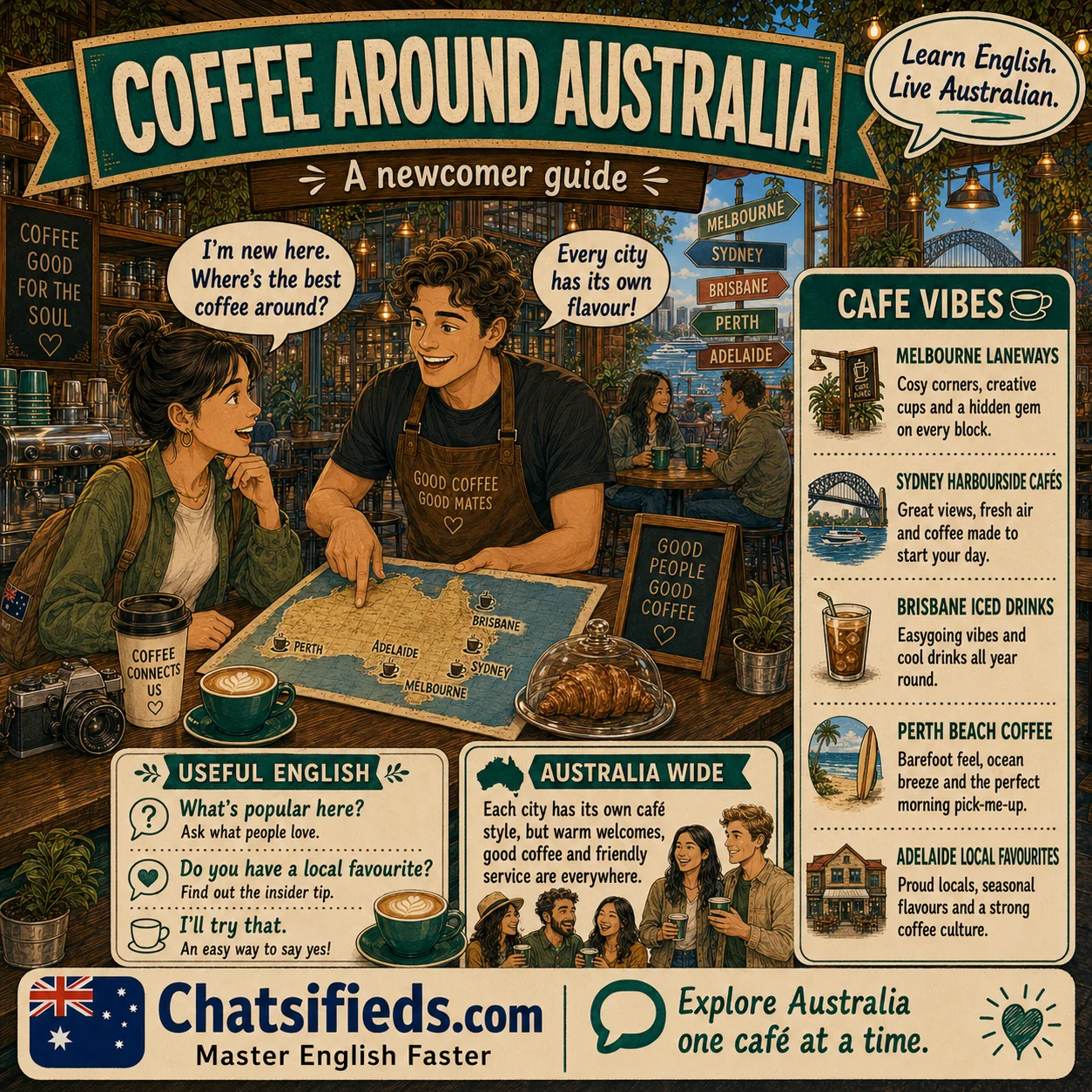
Australian cafés share many familiar drink names, but menus, sizes, beans, service style and specialties vary. The safest newcomer skill is learning how to ask rather than assuming every city or café follows one rule.
Understand the Australian context
Melbourne is strongly associated with specialty coffee and the magic. Other cities also have mature café scenes, roasters and local habits. Within one city, a suburban bakery, a university café and a specialty roaster may feel more different from each other than two cafés in different states.
Use menu clues to work out how a café runs: table service or counter service, cup sizes, house coffee, batch brew, alternative milk, surcharges and whether local specialty names appear.
Regional culture matters, but café type matters too. Avoid statements such as "everyone in Sydney drinks X" or "Brisbane cafés always do Y" unless you have good evidence.
Key words and phrases
- house coffee
- The standard coffee a café serves, often changing with the season.
- specialty coffee
- Coffee focused on beans, roasting and brewing quality.
- roaster
- A business that roasts coffee beans.
- batch brew
- Filter coffee made in a larger brewer.
- magic
- A Melbourne order for a small, strong milk coffee.
- counter service
- You order and pay at the counter.
- table service
- Staff take your order at the table.
- size labels
- The names a café uses for its cup sizes.
Conversation practice: asking in a new café
Customer: Hi, I am new here. I learned coffee English in Melbourne. Is it the same in Brisbane?
Barista: Mostly. A few names are different. What would you like?
Customer: What sizes do you have?
Barista: We use small and large here.
Customer: Thanks. Could I get a small flat white, please?
Barista: Sure. Our house coffee changes seasonally. Is that okay?
Customer: Yes, that is fine. Do I order at the counter?
Barista: Order at the counter when you are ready.
Customer: Great. Do you have a magic?
Barista: We do not call it that. I can make you a small, strong flat white.
Customer: Perfect, thanks.
Barista: No worries. Having here or takeaway?
- "We use small and large here" tells you the size labels are specific to this café.
- "Our house coffee changes seasonally" means the standard coffee can change during the year.
- If a local name is not used, you can describe the drink instead.
More useful phrases
- What sizes do you have?
- Which sizes can I choose from?Use it: Ask this in a new café.
- Do I order at the counter?
- Should I order here or at my table?Use it: Ask this when you are not sure how the café works.
- Do you have a magic?
- Do you make the Melbourne order called a magic?Use it: Ask this politely outside Melbourne.
- Could I get a small, strong flat white?
- A small flat white that is strong.Use it: Describe a drink when the name is not used.
- What is your house coffee?
- Which coffee do you use as your standard?Use it: Ask this to learn about the café.
- Is it different from other cafés?
- Does this café do things differently?Use it: A friendly question for a new place.
- Sorry, could you say that again?
- Please repeat what you said.Use it: Use this when you miss a word.
- Is this the same everywhere?
- Do all cafés use these words?Use it: Ask this when you move to a new city.
- Thanks, that is helpful.
- Thank you for explaining.Use it: A friendly reply to an explanation.
Say it in a real conversation
Use these sentences in a real conversation. The replies you hear will change from place to place.
| When | You can say | It means |
|---|---|---|
| Ask this in a new café. | What sizes do you have? | Which sizes can I choose from? |
| Ask this when you are not sure how the café works. | Do I order at the counter? | Should I order here or at my table? |
| Ask this politely outside Melbourne. | Do you have a magic? | Do you make the Melbourne order called a magic? |
| Describe a drink when the name is not used. | Could I get a small, strong flat white? | A small flat white that is strong. |
| Ask this to learn about the café. | What is your house coffee? | Which coffee do you use as your standard? |
| A friendly question for a new place. | Is it different from other cafés? | Does this café do things differently? |
Listen for the key words in the reply and answer in a short, clear sentence.
What you might hear
“We use small and large here.”
The size labels are specific to that cafe.
“Order at the counter when you are ready.”
This venue uses counter ordering.
“Our house coffee changes seasonally.”
The standard coffee selection may change.
What to avoid
A common mistake is learning one café as if it represents all of Australia. Build flexible language instead of rigid rules.
Say it aloud: ask this in a new café
Saying a sentence out loud before you need it makes real conversations easier. Accents differ, so aim to be clear, not perfect.
- Slow. Read the sentence slowly, one phrase at a time.
- In full. Say: What sizes do you have?
- At normal speed. Say it again, as you would in a real conversation.
- Listen. Listen for the key words in the reply.
Practice 1: Role-play with a partner
Situation: You are in a café in a new city and the sizes and drink names are slightly different from what you know. Ask the barista.
Work with a friend, a classmate or your mirror. One person is the barista. The other is customer. Read the lines, then cover the “You could say” answers and try it from memory. Swap roles.
barista: “Hi, how can I help?”
You could say:
- “Hi, I am new here. I learned coffee English in Melbourne. Is it the same in Brisbane?”
- “Is this the same everywhere?”
barista: “Mostly. A few names are different. What would you like?”
You could say:
- “What sizes do you have?”
- “Do you have a magic?”
barista: “We use small and large here.”
You could say:
- “Thanks. Could I get a small flat white, please?”
- “Could I get a small, strong flat white?”
barista: “Sure. Our house coffee changes seasonally. Is that okay?”
You could say:
- “Yes, that is fine. Do I order at the counter?”
- “Do I order at the counter?”
Challenge: Do the conversation again without looking at the lines, and change one detail.
Practice 2: Fill the gap
Say the missing word or phrase out loud before you open the answer.
What ___ do you have?
Show answer
sizes — The phrase means: Which sizes can I choose from?
Do I order at the ___?
Show answer
counter — The phrase means: Should I order here or at my table?
Do you have a ___?
Show answer
magic — The phrase means: Do you make the Melbourne order called a magic?
Could I get a small, ___ flat white?
Show answer
strong — The phrase means: A small flat white that is strong.
What is your house ___?
Show answer
coffee — The phrase means: Which coffee do you use as your standard?
Is it ___ from other cafés?
Show answer
different — The phrase means: Does this café do things differently?
Common mistakes and better ways to say it
Less helpful: “Learning one café as if it represents all of Australia.”
Try instead: “What sizes do you have?”
Build flexible language and ask. Café systems vary.
Less helpful: “Magic, please. (anywhere)”
Try instead: “Do you have a magic?”
The magic is strongly linked with Melbourne and may be less familiar elsewhere.
Less helpful: “Everyone here drinks X.”
Try instead: “This café seems to serve X.”
Avoid big claims about whole cities. Describe what you see in one café.
Less helpful: “Guessing what the sizes mean.”
Try instead: “What sizes do you have?”
Size labels differ between cafés. Asking is quick and polite.
Ask instead of assuming
Newcomers often learn café English in one city and then find a few differences in another. The differences are usually small: a size name, a milk charge, a local drink name.
A friendly question solves most of them. Baristas are used to people asking, and a short question shows you are interested in the café.
Advertisement
Real-life mission
Compare two cafés.
You do not need to buy anything. Saying the sentences aloud is good practice.
Phrase Wall practice: phrases to own
Open a phrase to see it on the Phrase Wall, practise it, and save it to My Learning.
- “What sizes do you have?”Which sizes can I choose from?
- “Do you have a magic?”Do you make the Melbourne order called a magic?
- “Could I get a small, strong flat white?”A small flat white that is strong.