
What you need to know
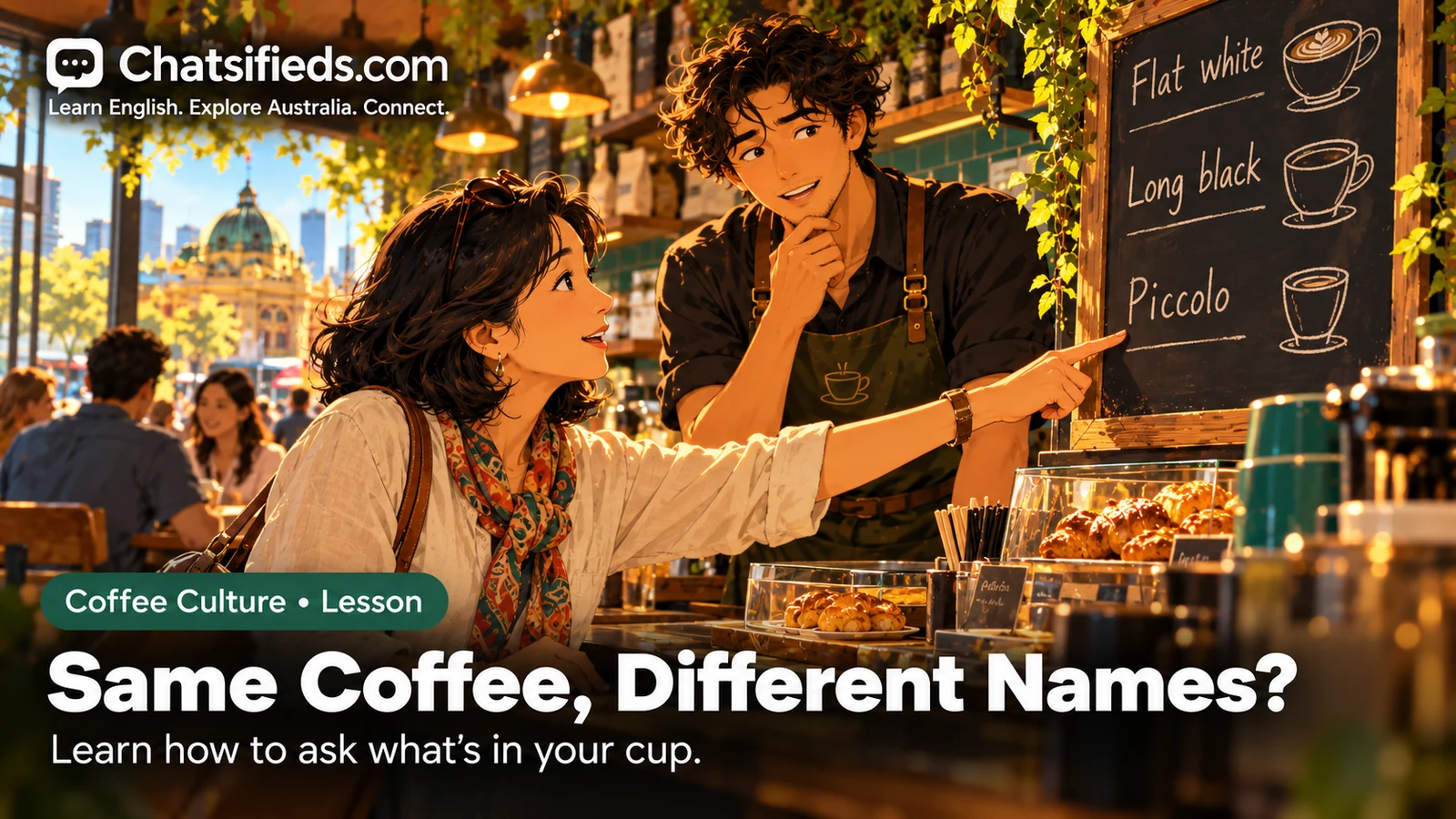
Names and sizes can vary between Australian cafés, so asking is smart. Say 'What is a magic?' or 'How big is a regular?' before you order. Baristas expect these questions.
Understand the Australian context
Tourism Australia says most cafés offer two sizes, regular and large, though some have more. It also notes that the great majority of cafés are independently owned, so each one tends to be a little different. That is a good reason to ask about names and sizes rather than guess.
A few differences are documented. A magic is a drink linked with Melbourne. Food writers describe it as a double ristretto with steamed milk in a small cup, close to a flat white. One article says a barista outside Melbourne may not know the word, and different publications describe the cup size differently. A long macchiato is another example, because one article says baristas make it in different ways, so they usually ask which style you want.
Iced coffee can also surprise visitors. Tourism Australia and a food publication say that ordering 'iced coffee' may bring a drink with ice cream, while an 'iced latte' is espresso, milk and ice. An SBS article adds that iced coffee may include extras like cream or flavouring. The simple rule is to ask what is in the drink if you are unsure.
Key words and phrases
- magic
- A small milk coffee linked with Melbourne, made with a ristretto shot
- ristretto
- A short espresso shot made with less water
- regular
- A size name some cafés use, which can mean different sizes in different places
- iced latte
- A cold drink of espresso, milk and ice
- iced coffee
- A cold coffee drink that may include ice cream or cream, depending on the café
- long macchiato
- A drink that baristas may make in different ways
- what's in it
- A casual way to ask about the ingredients
- size
- How big the cup is, for example small, regular or large
Conversation practice: checking a drink name
Customer: Hi there. Could I ask what a magic is?
Staff: Sure. It's a small milk coffee made with a ristretto shot.
Customer: Is it like a flat white?
Staff: It's similar, but it's usually smaller. Would you like to try one?
Customer: Maybe. How big is it compared with a regular?
Staff: A bit smaller than our regular. Our cups are on the counter, if you want to see.
Customer: Thanks, that helps. Then I'd also like an iced coffee. What's in it?
Staff: Ours has ice cream and cream. If you want the plain version, I can make an iced latte.
Customer: Oh, I see. An iced latte is better for me, please.
Staff: No worries. Anything else?
Customer: Just those two, thanks.
Staff: Great, I'll get those started.
- 'Could I ask what...' is a soft, polite way to start a question.
- 'How big is it compared with a regular?' helps because 'regular' can mean different things in different cafés.
- The staff answers in this dialogue are only an example. Real cafés may describe their drinks differently, so always listen to your own barista.
More useful phrases
- What exactly is a magic?
- Please explain this drink.Use it: When you see a menu word you do not know.
- How big is a regular here?
- What size is your regular cup?Use it: Before you choose a size.
- What's in an iced coffee here?
- Which ingredients does this drink contain?Use it: When you are unsure whether it has ice cream or milk only.
- Is it the same as a flat white?
- Is this drink similar or different?Use it: When you are comparing two drinks.
- Could I see the cup size?
- Please show me how big the cup is.Use it: When the size name is unclear.
- Which one would you recommend?
- Please suggest the best choice.Use it: When you are not sure what to order.
- Could I check what a magic is here?
- Names can vary, so asking is safer than assuming.Use it: Say this instead of "Magic coffee, same everywhere.".
- How big is a regular here, please?
- Size names can mean different things, so check before you order.Use it: Say this instead of "I want regular.".
Say it in a real conversation
Use these sentences in a real conversation. The replies you hear will change from place to place.
| When | You can say | It means |
|---|---|---|
| When you see a menu word you do not know. | What exactly is a magic? | Please explain this drink. |
| Before you choose a size. | How big is a regular here? | What size is your regular cup? |
| When you are unsure whether it has ice cream or milk only. | What's in an iced coffee here? | Which ingredients does this drink contain? |
| When you are comparing two drinks. | Is it the same as a flat white? | Is this drink similar or different? |
| When the size name is unclear. | Could I see the cup size? | Please show me how big the cup is. |
| When you are not sure what to order. | Which one would you recommend? | Please suggest the best choice. |
Listen for the key words in the reply and answer in a short, clear sentence.
Say it aloud: when you see a menu word you do not know
Saying a sentence out loud before you need it makes real conversations easier. Accents differ, so aim to be clear, not perfect.
- Slow. Read the sentence slowly, one phrase at a time.
- In full. Say: What exactly is a magic?
- At normal speed. Say it again, as you would in a real conversation.
- Listen. Listen for the key words in the reply.
Practice 1: Role-play with a partner
Situation: Imagine you are in a café in a new city and the menu has a word you do not know. Ask what the drink is, ask how big it is compared with a regular, and ask what is in it. Then place your order and thank the barista.
Work with a friend, a classmate or your mirror. One person is the staff. The other is customer. Read the lines, then cover the “You could say” answers and try it from memory. Swap roles.
staff: “Hi, how can I help?”
You could say:
- “Hi there. Could I ask what a magic is?”
- “Which one would you recommend?”
staff: “Sure. It's a small milk coffee made with a ristretto shot.”
You could say:
- “Is it like a flat white?”
- “What exactly is a magic?”
staff: “It's similar, but it's usually smaller. Would you like to try one?”
You could say:
- “Maybe. How big is it compared with a regular?”
- “How big is a regular here?”
staff: “A bit smaller than our regular. Our cups are on the counter, if you want to see.”
You could say:
- “Thanks, that helps. Then I'd also like an iced coffee. What's in it?”
- “What's in an iced coffee here?”
Challenge: Do the conversation again without looking at the lines, and change one detail.
Practice 2: Fill the gap
Say the missing word or phrase out loud before you open the answer.
What ___ is a magic?
Show answer
exactly — The phrase means: Please explain this drink.
How big is a ___ here?
Show answer
regular — The phrase means: What size is your regular cup?
What's in an iced ___ here?
Show answer
coffee — The phrase means: Which ingredients does this drink contain?
Is it the same as a flat ___?
Show answer
white — The phrase means: Is this drink similar or different?
Which one would you ___?
Show answer
recommend — The phrase means: Please suggest the best choice.
Could I check what a ___ is here?
Show answer
magic — The phrase means: Names can vary, so asking is safer than assuming.
Common mistakes and better ways to say it
Less helpful: “Magic coffee, same everywhere.”
Try instead: “Could I check what a magic is here?”
Names can vary, so asking is safer than assuming.
Less helpful: “I want regular.”
Try instead: “How big is a regular here, please?”
Size names can mean different things, so check before you order.
Less helpful: “Iced coffee, nothing else.”
Try instead: “What's in your iced coffee, please?”
The drink can include extras like ice cream, so asking avoids a surprise.
Less helpful: “What is this word?”
Try instead: “Sorry, could you explain what that drink is?”
A complete, polite question sounds friendly and is easy to answer.
Why asking is normal, not rude
Because many cafés are independently owned, each one may name or size its drinks in its own way. Baristas often explain menu words many times a day, so a friendly question is a normal part of ordering, not a problem.
Visitors and new residents sometimes feel shy about asking. A simple opener like 'Sorry, quick question' helps. You can also point at the cup sizes or look at the menu board together. Avoid assuming that a name you learned in one city means exactly the same drink in another. Treat each café as a new conversation, and thank the barista for their help.
Advertisement
Real-life mission
Practise this lesson in real life.
You do not need to buy anything. Saying the sentences aloud is good practice.
Phrase Wall practice: phrases to own
Open a phrase to see it on the Phrase Wall, practise it, and save it to My Learning.
- “How big is a regular here?”What size is your regular cup?
- “What exactly is a magic?”Please explain this drink.
- “What's in an iced coffee here?”Which ingredients does this drink contain?