
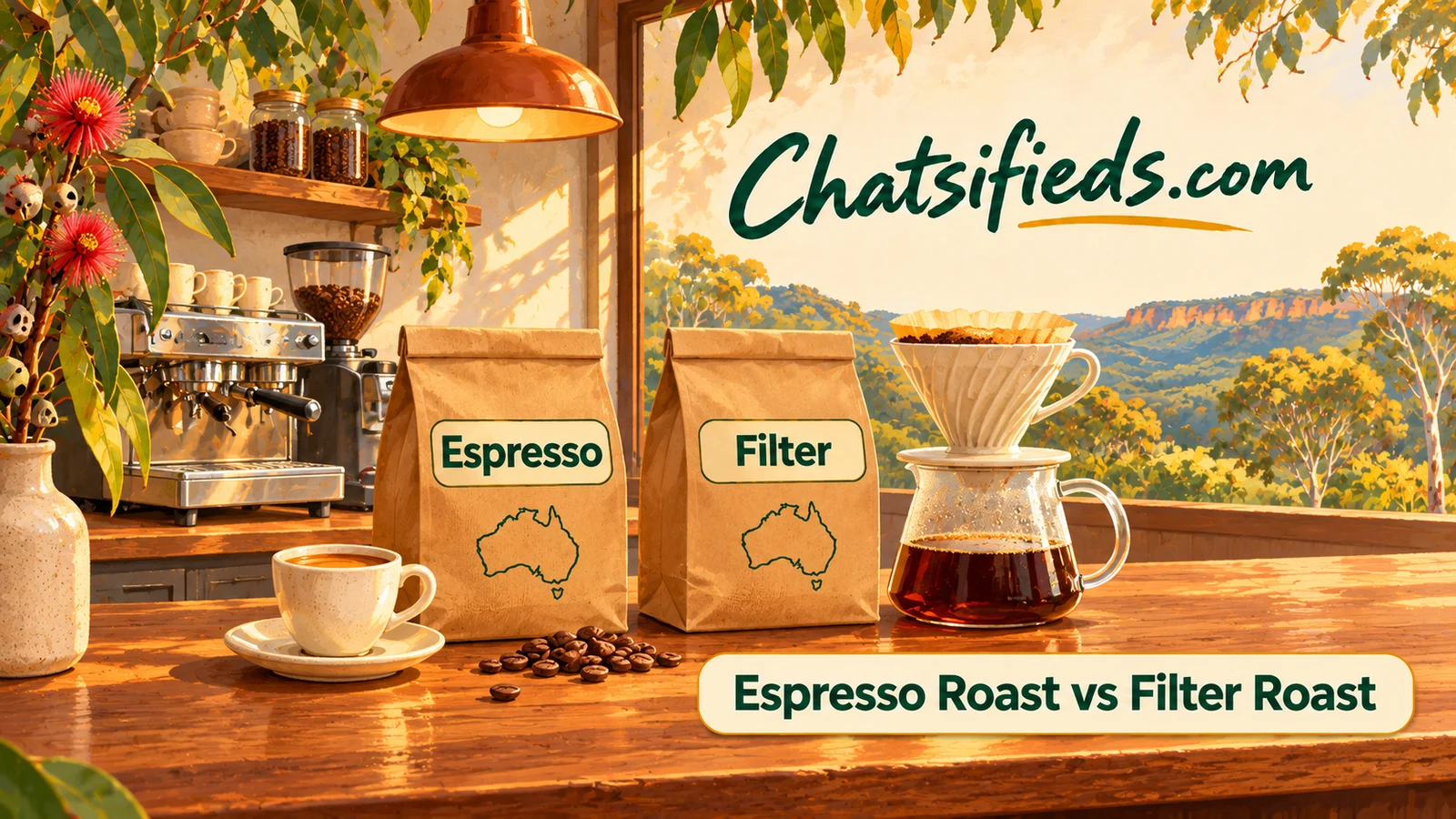
What you need to know
"Espresso roast" and "filter roast" are the roaster's recommendation for how a coffee should be brewed, not different kinds of bean. The labels are not absolute rules, and some roasters make "omni" roasts for several methods. Tell staff your brewer and what you like to drink.
Understand the Australian context
Espresso and filter use different brewing conditions, so roasters may develop or label coffees to suit one approach. In broad terms, espresso-labelled coffees are often developed to extract comfortably as espresso, and filter-labelled coffees may preserve more clarity. No single rule applies to every roaster.
A 20-second decision helps. Name your brewer (espresso machine, moka pot, AeroPress, plunger, V60 or batch brewer), say whether you drink black coffee or milk coffee, and ask one question such as "Is this for espresso or filter?".
An omni roast is designed by some roasters to work across several methods. If you are unsure, ask how they would brew it.
Key words and phrases
- espresso roast
- A coffee roasted with espresso in mind.
- filter roast
- A coffee roasted with filter brewing in mind.
- omni roast
- A roast meant for several methods.
- roaster
- A person or business that roasts coffee.
- brew method
- The way you make coffee.
- clarity
- A clean, clear taste.
- body
- How full the coffee feels.
- label
- The description on a bag.
Conversation practice: choosing a roast for your brewer
Customer: Hi. I have an espresso machine at home. What do you recommend?
Staff: Great. Do you mostly drink milk coffee or black?
Customer: Mostly flat whites.
Staff: Then an espresso roast is a good start.
Customer: What is the difference between espresso and filter roast?
Staff: They are roasting and brewing recommendations, not different beans.
Customer: Could I use a filter roast in my machine?
Staff: You can try. The labels are guides, not rules.
Customer: Is there an omni roast?
Staff: Yes, this one is meant to work for both.
Customer: Would it work well in a flat white?
Staff: It should. I will grind a small bag so you can try.
- The customer starts with the brewer and the drink.
- "Guides, not rules" explains the labels.
- "Would it work well in a flat white?" connects a bag to a drink.
More useful phrases
- I have an espresso machine. What do you recommend?
- Which coffee suits my machine?Use it: Start with your brewer.
- Is this for espresso or filter?
- Which brewing method is it for?Use it: Ask about the label.
- Would this work well in a flat white?
- Is it good with milk?Use it: Ask about milk drinks.
- Is this for V60 or batch brew?
- Is it a filter coffee?Use it: Ask about filter.
- What is an omni roast?
- Is it for many methods?Use it: Ask about the term.
- How would you brew this?
- What method do you suggest?Use it: Ask the roaster.
- Could I try a small bag first?
- May I buy a small amount?Use it: Test before a big bag.
- Sorry, could you say that again?
- Please repeat what you said.Use it: Use this when you miss a word.
- Thanks, have a good one.
- Thank you, and I hope your day goes well.Use it: A friendly way to finish.
Say it in a real conversation
Use these sentences in a real conversation. The replies you hear will change from place to place.
| When | You can say | It means |
|---|---|---|
| Start with your brewer. | I have an espresso machine. What do you recommend? | Which coffee suits my machine? |
| Ask about the label. | Is this for espresso or filter? | Which brewing method is it for? |
| Ask about milk drinks. | Would this work well in a flat white? | Is it good with milk? |
| Ask about filter. | Is this for V60 or batch brew? | Is it a filter coffee? |
| Ask about the term. | What is an omni roast? | Is it for many methods? |
| Ask the roaster. | How would you brew this? | What method do you suggest? |
Listen for the key words in the reply and answer in a short, clear sentence.
Useful words at a glance
| Label | Common intention | Useful learner question |
|---|---|---|
| Espresso roast | Developed for concentrated espresso extraction; often aims for balance, sweetness and body. | “Would this work well in a flat white?” |
| Filter roast | Developed for filter methods where clarity and origin character can be prominent. | “Is this for V60 or batch brew?” |
| Omni roast | Designed by some roasters to work across multiple brew methods. | “How would you brew this?” |
Say it aloud: start with your brewer
Saying a sentence out loud before you need it makes real conversations easier. Accents differ, so aim to be clear, not perfect.
- Slow. Read the sentence slowly, one phrase at a time.
- In full. Say: I have an espresso machine. What do you recommend?
- At normal speed. Say it again, as you would in a real conversation.
- Listen. Listen for the key words in the reply.
Practice 1: Role-play with a partner
Situation: You are buying beans for your home espresso machine. Say what you use and ask whether a roast suits milk coffee.
Work with a friend, a classmate or your mirror. One person is the staff. The other is customer. Read the lines, then cover the “You could say” answers and try it from memory. Swap roles.
staff: “Hi, how can I help?”
You could say:
- “Hi. I have an espresso machine at home. What do you recommend?”
- “I have an espresso machine. What do you recommend?”
staff: “Great. Do you mostly drink milk coffee or black?”
You could say:
- “Mostly flat whites.”
- “Would this work well in a flat white?”
staff: “Then an espresso roast is a good start.”
You could say:
- “What is the difference between espresso and filter roast?”
- “Is this for espresso or filter?”
staff: “They are roasting and brewing recommendations, not different beans.”
You could say:
- “Could I use a filter roast in my machine?”
- “Could I try a small bag first?”
Challenge: Do the conversation again without looking at the lines, and change one detail.
Practice 2: Fill the gap
Say the missing word or phrase out loud before you open the answer.
I have an espresso machine. What do you ___?
Show answer
recommend — The phrase means: Which coffee suits my machine?
Is this for ___ or filter?
Show answer
espresso — The phrase means: Which brewing method is it for?
Would this work well in a flat ___?
Show answer
white — The phrase means: Is it good with milk?
Is this for V60 or ___ brew?
Show answer
batch — The phrase means: Is it a filter coffee?
What is an omni ___?
Show answer
roast — The phrase means: Is it for many methods?
Could I try a small bag ___?
Show answer
first — The phrase means: May I buy a small amount?
Common mistakes and better ways to say it
Less helpful: “Espresso roast is a different bean.”
Try instead: “Espresso roast is a roaster's recommendation.”
The same origin can be roasted differently.
Less helpful: “The labels are strict rules.”
Try instead: “The labels are guides.”
You can experiment.
Less helpful: “Guessing from the bag.”
Try instead: “I have an espresso machine. What do you recommend?”
Tell staff your brewer first.
Less helpful: “Roast me a bag.”
Try instead: “Is this for espresso or filter?”
Use a clear buying question.
Tell them your brewer
Australian specialty roasters often print "espresso" or "filter" on the bag. Staff expect questions from home brewers.
Tell them how you brew and whether you drink milk coffee or black coffee. It is more useful than guessing.
Advertisement
Real-life mission
Make a 20-second decision.
You do not need to buy anything. Saying the sentences aloud is good practice.
Phrase Wall practice: phrases to own
Open a phrase to see it on the Phrase Wall, practise it, and save it to My Learning.
- “Is this for espresso or filter?”Which brewing method is it for?
- “Is this for V60 or batch brew?”Is it a filter coffee?
- “What is an omni roast?”Is it for many methods?