
What you need to know
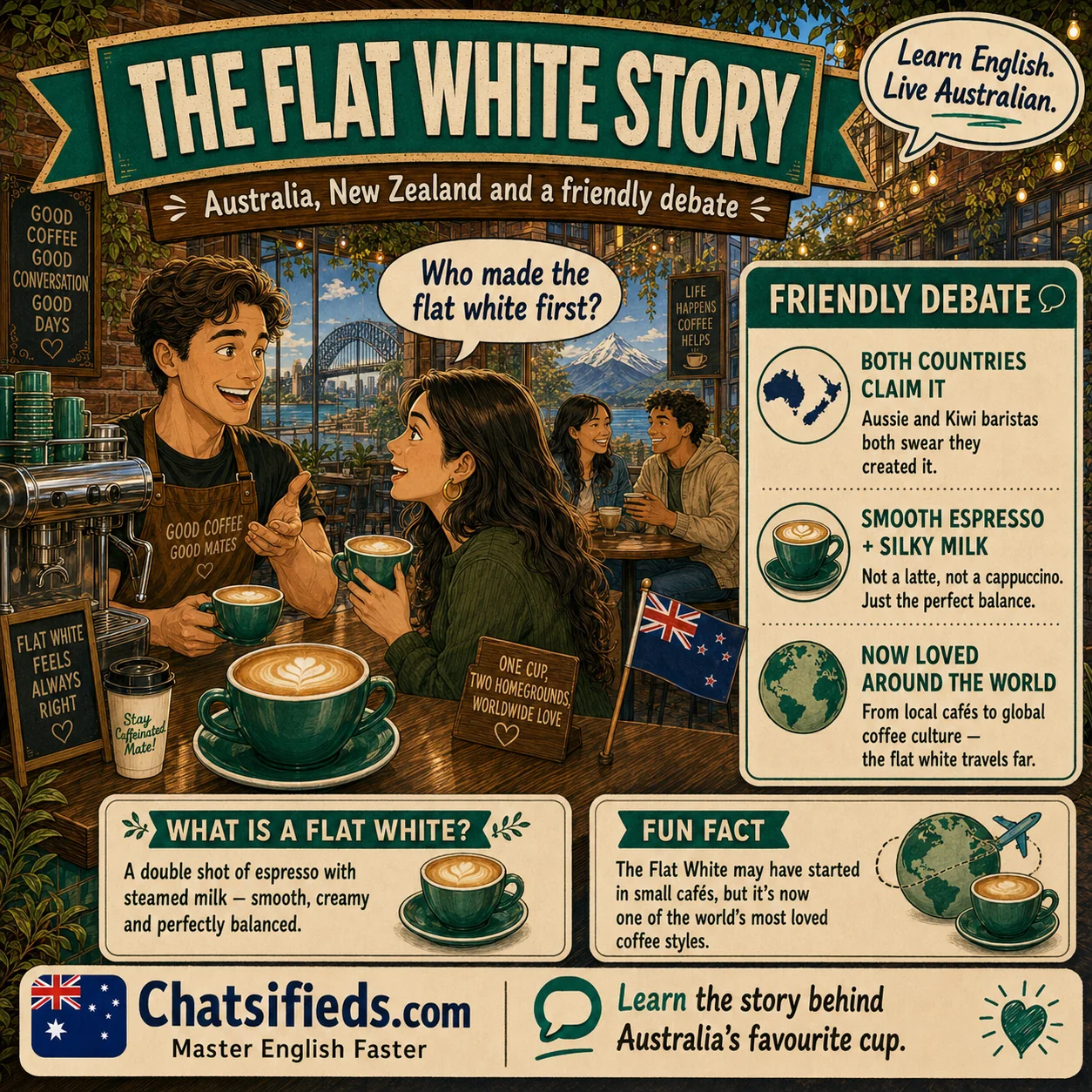
The flat white is strongly associated with both Australia and New Zealand, and its exact origin is disputed. A careful sentence for class is: "The flat white is strongly associated with Australia and New Zealand, but its exact origin is disputed."
Understand the Australian context
The flat white is strongly associated with both Australia and New Zealand, and its exact origin is disputed. Sources such as Wikipedia and The Conversation report that Moors Espresso Bar in Sydney had "flat white" on its menu in 1985, while New Zealand cafés in Auckland and Wellington also claim the drink. For learners, the interesting part is not choosing a winner.
The evidence is mixed. Wikipedia notes the name was used in England for an espresso coffee in the 1960s, and an earlier Sydney café review from 1983 mentions a "flat white coffee". Alan Preston, who ran Moors, says he brought the idea from Queensland, where Italian cane farmers drank "flat" white coffee. New Zealand claims, such as a 1989 Wellington story, rest mostly on memories of the people involved.
A cultural origin claim is different from proving who made the first similar drink. Good history separates documented names, memories, recipes and later popularisation. That is why careful speakers say "disputed" or "strongly associated" instead of "invented by".
The drink itself also varies. Cup size, shot recipe and milk texture change between cafés, so a flat white is better understood as a style of espresso-and-milk drink than a mathematical formula. A friendly café conversation about the debate is common and usually good-humoured.
Key words and phrases
- disputed
- Not agreed by everyone.
- origin
- Where something began.
- claim
- A statement that something is true.
- evidence
- Facts that support an idea.
- associated with
- Connected with in people's minds.
- rivalry
- Friendly competition.
- documented
- Recorded in writing.
- popularisation
- Becoming widely popular.
Conversation practice: who invented the flat white?
You: Who invented the flat white?
Friend: That depends who you ask. Australia and New Zealand both have claims.
You: Is there any evidence?
Friend: There is a Sydney menu from the mid-1980s, but New Zealand has stories too.
You: So it is not settled?
Friend: Not really. People still disagree.
You: What should I say in class?
Friend: Say the origin is disputed and explain the evidence you found.
You: Is it okay to say it is Australian?
Friend: Better to say it is strongly associated with both countries.
You: That sounds careful. Thanks.
Friend: No worries. Good luck with the presentation.
- "Depends who you ask" shows that opinions differ.
- "Disputed" is the careful word for an unsettled origin.
- The friend suggests explaining your evidence, not just giving a conclusion.
More useful phrases
- The origin is disputed.
- People do not agree.Use it: A careful phrase.
- It is strongly associated with both countries.
- Both countries link it to themselves.Use it: Avoid overclaiming.
- That depends who you ask.
- Opinions differ.Use it: A natural reply.
- There are a few origin stories.
- No single account is accepted.Use it: Describe an unsettled history.
- The evidence I found was...
- I will show my source.Use it: Use it in a presentation.
- Aussies and Kiwis both claim it.
- Both groups say it began with them.Use it: Friendly and informal.
- Our version is a double shot.
- This is our recipe.Use it: A café describing its own drink.
- Sorry, what does that mean?
- Please explain the word.Use it: Ask instead of guessing.
- Thanks, have a good one.
- Thank you, and I hope your day goes well.Use it: A friendly way to finish.
Say it in a real conversation
Use these sentences in a real conversation. The replies you hear will change from place to place.
| When | You can say | It means |
|---|---|---|
| A careful phrase. | The origin is disputed. | People do not agree. |
| Avoid overclaiming. | It is strongly associated with both countries. | Both countries link it to themselves. |
| A natural reply. | That depends who you ask. | Opinions differ. |
| Describe an unsettled history. | There are a few origin stories. | No single account is accepted. |
| Use it in a presentation. | The evidence I found was... | I will show my source. |
| Friendly and informal. | Aussies and Kiwis both claim it. | Both groups say it began with them. |
Listen for the key words in the reply and answer in a short, clear sentence.
What you might hear
“Aussies and Kiwis both claim it.”
The speaker is referring to the Australia-New Zealand debate.
“There are a few origin stories.”
The history is not settled in one simple account.
“Our version is a double shot.”
The cafe is describing its recipe, not the universal definition.
Say it aloud: a careful phrase
Saying a sentence out loud before you need it makes real conversations easier. Accents differ, so aim to be clear, not perfect.
- Slow. Read the sentence slowly, one phrase at a time.
- In full. Say: The origin is disputed.
- At normal speed. Say it again, as you would in a real conversation.
- Listen. Listen for the key words in the reply.
Practice 1: Role-play with a partner
Situation: A classmate asks who invented the flat white. Answer carefully and say what you know.
Work with a friend, a classmate or your mirror. One person is the friend. The other is you. Read the lines, then cover the “You could say” answers and try it from memory. Swap roles.
friend: “Hi, how can I help?”
You could say:
- “Who invented the flat white?”
- “There are a few origin stories.”
friend: “That depends who you ask. Australia and New Zealand both have claims.”
You could say:
- “Is there any evidence?”
- “The origin is disputed.”
friend: “There is a Sydney menu from the mid-1980s, but New Zealand has stories too.”
You could say:
- “So it is not settled?”
- “It is strongly associated with both countries.”
friend: “Not really. People still disagree.”
You could say:
- “What should I say in class?”
- “The evidence I found was...”
Challenge: Do the conversation again without looking at the lines, and change one detail.
Practice 2: Fill the gap
Say the missing word or phrase out loud before you open the answer.
The origin is ___.
Show answer
disputed — The phrase means: People do not agree.
It is strongly ___ with both countries.
Show answer
associated — The phrase means: Both countries link it to themselves.
That ___ who you ask.
Show answer
depends — The phrase means: Opinions differ.
There are a few origin ___.
Show answer
stories — The phrase means: No single account is accepted.
The ___ I found was...
Show answer
evidence — The phrase means: I will show my source.
Aussies and Kiwis both ___ it.
Show answer
claim — The phrase means: Both groups say it began with them.
Common mistakes and better ways to say it
Less helpful: “Saying "It was definitely invented in Sydney."”
Try instead: “It is strongly associated with Australia and New Zealand.”
The origin is disputed.
Less helpful: “Saying "Only New Zealand makes a real flat white."”
Try instead: “Recipes vary by café.”
There is no single true recipe.
Less helpful: “Saying "Nobody knows anything."”
Try instead: “There is some evidence, but it is disputed.”
Evidence exists.
Less helpful: “Treating a story as proven.”
Try instead: “One story says...”
Separate documents from memories.
Friendly rivalry
Australians and New Zealanders often joke about who owns the flat white. Joining in lightly is fine, but avoid stating an uncertain story as proven fact.
Acknowledging both countries' claims is a polite and accurate approach in class, at work or in a café chat.
Advertisement
Real-life mission
Find two sources about the flat white.
You do not need to buy anything. Saying the sentences aloud is good practice.
Phrase Wall practice: phrases to own
Open a phrase to see it on the Phrase Wall, practise it, and save it to My Learning.
- “The origin is disputed.”People do not agree.
- “It is strongly associated with both countries.”Both countries link it to themselves.
- “That depends who you ask.”Opinions differ.