
What you need to know
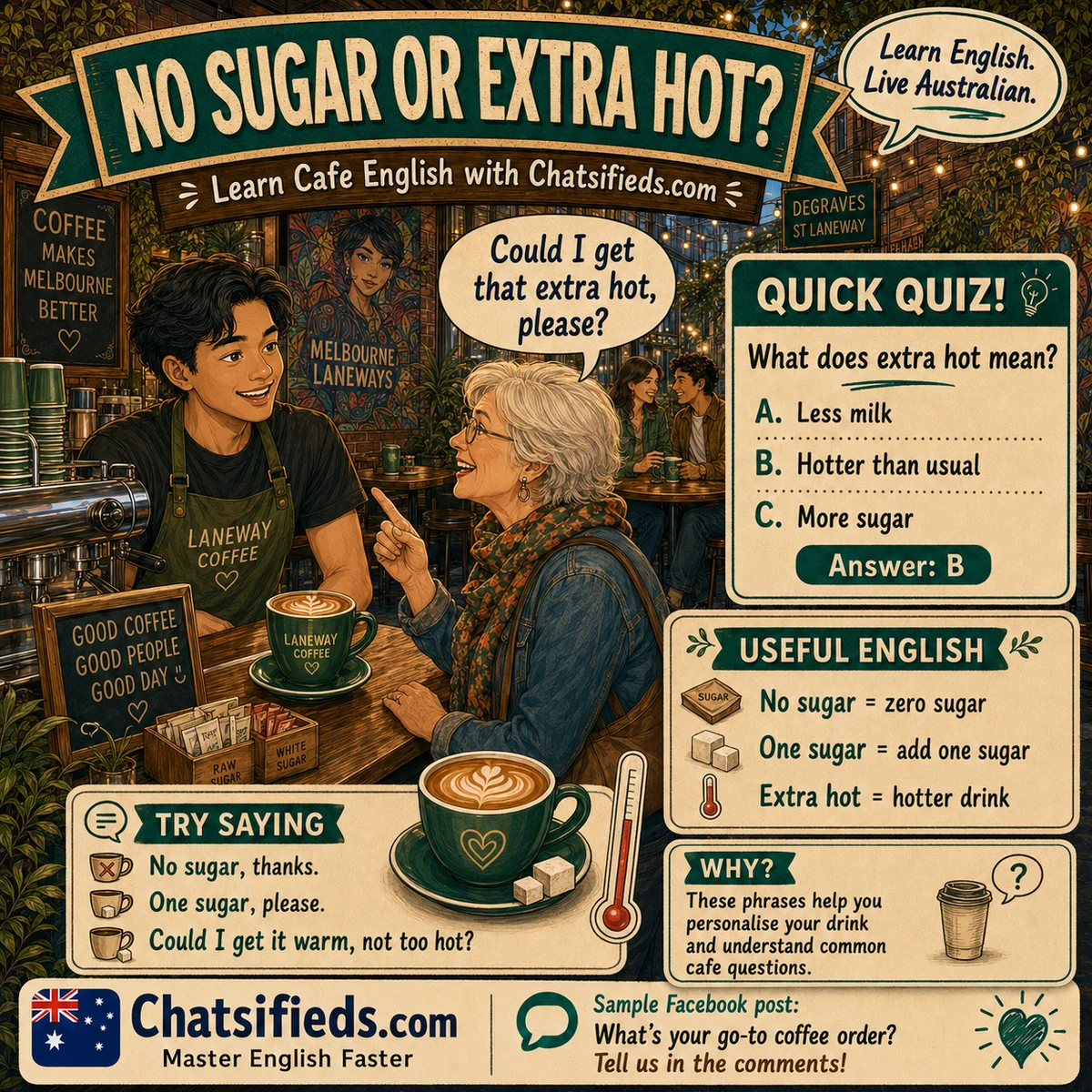
Use short polite phrases for sugar and temperature: "No sugar, thanks", "One sugar, please", "Could I get it extra hot, please?" and "Could I get it warm, please?". "Sugar on the side" means sugar is separate so you can add it yourself.
Understand the Australian context
Some people like coffee hot, warm, sweet or unsweetened. It is normal to ask for small changes politely. A short sentence is enough: you do not need to explain.
For sugar, say "No sugar, thanks" or "One sugar, please". Many cafés keep sugar on the counter so you can add your own. For temperature, say "extra hot" for hotter than usual or "warm" for not too hot, which is useful for children or if you sip slowly.
You may be asked "Anything else?" or "Sugar?". Answer briefly. If you do not understand, say "Sorry, could you say that again?". Cafés make drinks slightly differently, so the result may vary.
Key words and phrases
- no sugar
- No sugar added.
- one sugar
- One spoon or sachet of sugar.
- extra hot
- Hotter than usual.
- warm
- Not too hot.
- sugar on the side
- Sugar served separately.
- sweet
- With sugar or sweetness.
- unsweetened
- Without sugar.
- sachet
- A small packet.
Conversation practice: sugar and temperature
Customer: Could I get a flat white, please?
Barista: Sure. Regular or large?
Customer: Regular, thanks. Could I get it extra hot, please?
Barista: No worries. Any sugar?
Customer: No sugar, thanks.
Barista: Cool. Anything else?
Customer: Could I also get a hot chocolate for my daughter, warm, please?
Barista: Sure, warm, not hot.
Customer: Thanks. Is it very sweet?
Barista: It is a little sweet, with no extra sugar.
Customer: Perfect. Takeaway, please.
Barista: No worries. Name for the order?
- "Extra hot" and "warm" are opposite requests.
- "No sugar, thanks" answers "Any sugar?".
- "Is it very sweet?" is a useful question for sweet drinks.
More useful phrases
- No sugar, thanks.
- I do not want sugar.Use it: Say no sugar.
- One sugar, please.
- I would like one sugar.Use it: Ask for sugar.
- Could I get it extra hot, please?
- Please make it hotter.Use it: Ask for extra hot.
- Could I get it warm, please?
- Please make it not too hot.Use it: Ask for warm.
- Could I have sugar on the side?
- Please give sugar separately.Use it: Control the sugar.
- Is it very sweet?
- Does it have a lot of sugar?Use it: Ask about sweetness.
- Not too hot, please.
- A little cooler, please.Use it: Another way to say it.
- Sorry, could you say that again?
- Please repeat what you said.Use it: Use this when you miss a word.
- Thanks, have a good one.
- Thank you, and I hope your day goes well.Use it: A friendly way to finish.
Say it in a real conversation
Use these sentences in a real conversation. The replies you hear will change from place to place.
| When | You can say | It means |
|---|---|---|
| Say no sugar. | No sugar, thanks. | I do not want sugar. |
| Ask for sugar. | One sugar, please. | I would like one sugar. |
| Ask for extra hot. | Could I get it extra hot, please? | Please make it hotter. |
| Ask for warm. | Could I get it warm, please? | Please make it not too hot. |
| Control the sugar. | Could I have sugar on the side? | Please give sugar separately. |
| Ask about sweetness. | Is it very sweet? | Does it have a lot of sugar? |
Listen for the key words in the reply and answer in a short, clear sentence.
Useful words at a glance
| Café English | What it means | Useful phrase |
|---|---|---|
| No sugar | No sugar added | No sugar, thanks. |
| One sugar | One spoon or sachet of sugar | One sugar, please. |
| Extra hot | Hotter than usual | Could I get it extra hot? |
| Warm | Not too hot | Could I get it warm, please? |
Say it aloud: say no sugar
Saying a sentence out loud before you need it makes real conversations easier. Accents differ, so aim to be clear, not perfect.
- Slow. Read the sentence slowly, one phrase at a time.
- In full. Say: No sugar, thanks.
- At normal speed. Say it again, as you would in a real conversation.
- Listen. Listen for the key words in the reply.
Practice 1: Role-play with a partner
Situation: You want an extra hot flat white with no sugar. Order it and ask for a warm hot chocolate for a child.
Work with a friend, a classmate or your mirror. One person is the barista. The other is customer. Read the lines, then cover the “You could say” answers and try it from memory. Swap roles.
barista: “Hi, how can I help?”
You could say:
- “Could I get a flat white, please?”
- “Could I have sugar on the side?”
barista: “Sure. Regular or large?”
You could say:
- “Regular, thanks. Could I get it extra hot, please?”
- “Could I get it extra hot, please?”
barista: “No worries. Any sugar?”
You could say:
- “No sugar, thanks.”
- “One sugar, please.”
barista: “Cool. Anything else?”
You could say:
- “Could I also get a hot chocolate for my daughter, warm, please?”
- “Could I get it warm, please?”
Challenge: Do the conversation again without looking at the lines, and change one detail.
Practice 2: Fill the gap
Say the missing word or phrase out loud before you open the answer.
Could I get it ___ hot, please?
Show answer
extra — The phrase means: Please make it hotter.
Could I have ___ on the side?
Show answer
sugar — The phrase means: Please give sugar separately.
Is it very ___?
Show answer
sweet — The phrase means: Does it have a lot of sugar?
No sugar added. The word is ___.
Show answer
no sugar — "no sugar": No sugar added.
One spoon or sachet of sugar. The word is ___.
Show answer
one sugar — "one sugar": One spoon or sachet of sugar.
Hotter than usual. The word is ___.
Show answer
extra hot — "extra hot": Hotter than usual.
Common mistakes and better ways to say it
Less helpful: “Sweet me.”
Try instead: “One sugar, please.”
A short polite phrase is clearer.
Less helpful: “Hot fast now.”
Try instead: “Could I get it extra hot, please?”
Polite phrases are friendlier.
Less helpful: “No sweet person.”
Try instead: “No sugar, thanks.”
Use the simple phrase.
Less helpful: “Giving a very hot drink to a child.”
Try instead: “Could I get it warm, please?”
Ask for warm for children.
Small changes are normal
Australian cafés are used to small requests about sugar and temperature. One short polite sentence is enough.
Recipes and sweetness vary, so ask if you are unsure.
Advertisement
Real-life mission
Practise four phrases.
You do not need to buy anything. Saying the sentences aloud is good practice.
Phrase Wall practice: phrases to own
Open a phrase to see it on the Phrase Wall, practise it, and save it to My Learning.
- “Could I get it extra hot, please?”Please make it hotter.
- “Could I get it warm, please?”Please make it not too hot.
- “Could I have sugar on the side?”Please give sugar separately.