
What you need to know
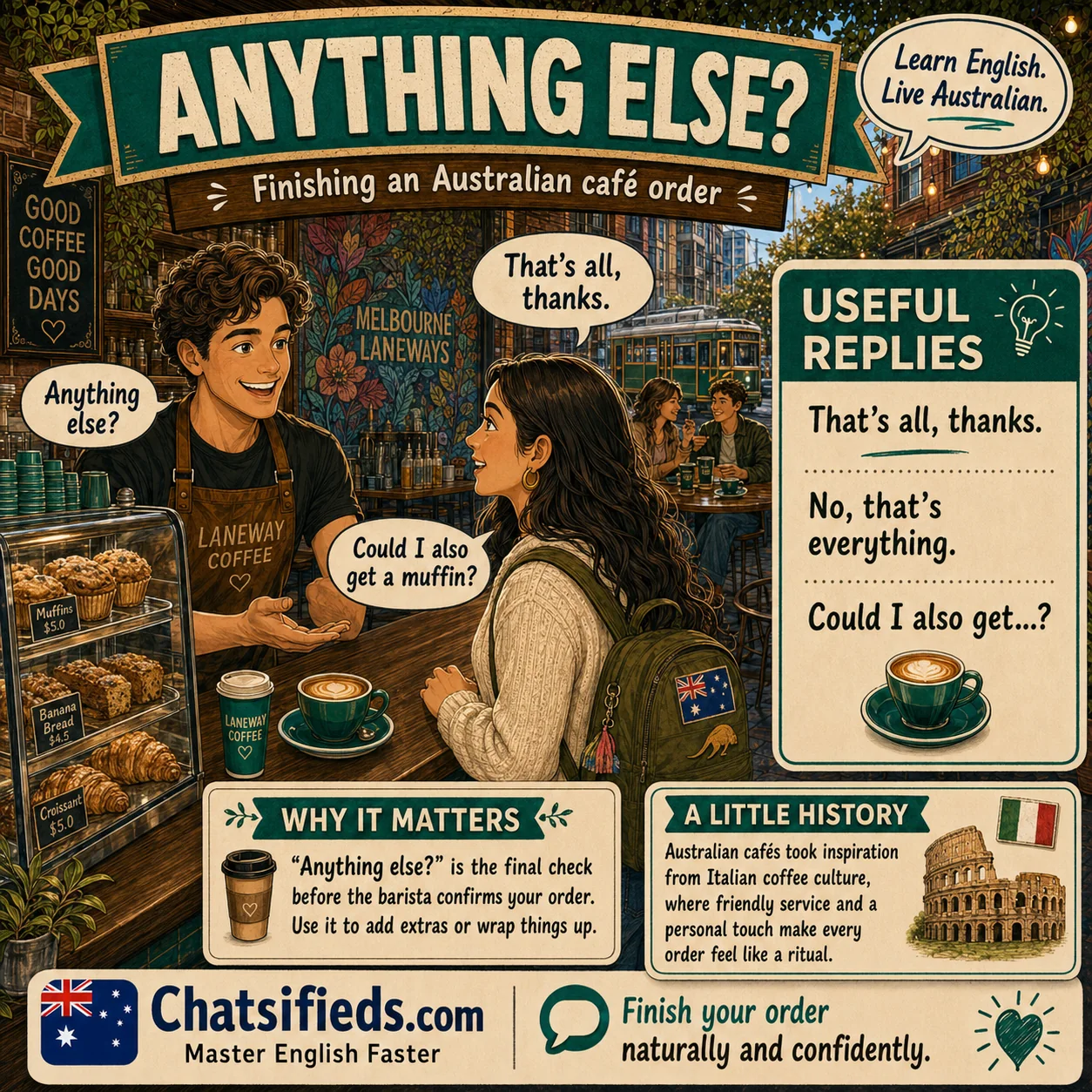
"Anything else?" is a simple invitation to add another item before the order is finalised. You can say "No, that is all, thanks" or add food or another drink. Listen for the words "else" and "all" before you answer.
Understand the Australian context
At the end of an order, the barista checks whether you want to add anything. This is also your last easy chance to change the order before payment.
The two answers are opposites: "Yes, could I add a banana bread, please?" and "No, that is all, thanks". Learners sometimes answer "yes" when they mean "no", so listen for the key word before you answer.
Staff may ask again after you add something, because the order has changed. Food often brings another question, such as "Warmed up?", which means heated before serving.
Key words and phrases
- anything else
- A question asking whether you want more.
- that is all
- A phrase meaning you do not want anything more.
- add
- Include one more item.
- warmed up
- Heated before serving.
- finalise
- Make the order complete.
- change
- Alter the order.
- everything
- All items together.
- total
- The full amount to pay.
Conversation practice: finishing an order
Barista: Anything else?
Student: Yes, could I add a banana bread, please?
Barista: Sure. Warmed up?
Student: Yes, please.
Barista: Great. Anything else?
Student: No, that is all, thanks.
Barista: That will be eleven forty.
Student: Can I tap?
Barista: Yep, go for it.
Student: Thanks.
Barista: What name for the order?
Student: Paul, thanks.
- "Warmed up?" is a food question. Answer yes or no.
- The barista asks "Anything else?" twice because the order changed.
- "That is all" is a polite, clear way to finish.
More useful phrases
- No, that is all, thanks.
- I do not want anything else.Use it: The usual way to finish.
- Yes, could I add a banana bread, please?
- I would like to add banana bread.Use it: Use this to add an item.
- Actually, could I add a muffin?
- I changed my mind and want a muffin.Use it: Use this to add something late.
- Yes please. Warmed up.
- Please heat it.Use it: Answer to "Warmed up?".
- No thanks, just the coffee.
- Only the coffee, please.Use it: Another way to finish.
- Is that everything?
- Is the order complete?Use it: A question you may hear.
- Could I change the milk to oat?
- Please use oat milk.Use it: Change a detail before you pay.
- Sorry, could you say that again?
- Please repeat what you said.Use it: Use this when you miss a word.
- Thanks, have a good one.
- Thank you, and I hope your day goes well.Use it: A friendly way to finish at the counter.
Say it in a real conversation
Use these sentences in a real conversation. The replies you hear will change from place to place.
| When | You can say | It means |
|---|---|---|
| The usual way to finish. | No, that is all, thanks. | I do not want anything else. |
| Use this to add an item. | Yes, could I add a banana bread, please? | I would like to add banana bread. |
| Use this to add something late. | Actually, could I add a muffin? | I changed my mind and want a muffin. |
| Answer to "Warmed up?". | Yes please. Warmed up. | Please heat it. |
| Another way to finish. | No thanks, just the coffee. | Only the coffee, please. |
| A question you may hear. | Is that everything? | Is the order complete? |
Listen for the key words in the reply and answer in a short, clear sentence.
What you might hear
“Anything else today?”
Add another item or finish.
“Is that everything?”
The barista is checking the order is complete.
“Any food?”
They are asking whether you want something to eat.
Say it aloud: the usual way to finish
Saying a sentence out loud before you need it makes real conversations easier. Accents differ, so aim to be clear, not perfect.
- Slow. Read the sentence slowly, one phrase at a time.
- In full. Say: No, that is all, thanks.
- At normal speed. Say it again, as you would in a real conversation.
- Listen. Listen for the key words in the reply.
Practice 1: Role-play with a partner
Situation: The barista asks "Anything else?" You want to add banana bread and then finish.
Work with a friend, a classmate or your mirror. One person is the student. The other is barista. Read the lines, then cover the “You could say” answers and try it from memory. Swap roles.
student: “Hi, how can I help?”
You could say:
- “Anything else?”
- “Actually, could I add a muffin?”
student: “Yes, could I add a banana bread, please?”
You could say:
- “Sure. Warmed up?”
- “Yes please. Warmed up.”
student: “Yes, please.”
You could say:
- “Great. Anything else?”
- “No, that is all, thanks.”
student: “No, that is all, thanks.”
You could say:
- “That will be eleven forty.”
- “Is that everything?”
Challenge: Do the conversation again without looking at the lines, and change one detail.
Practice 2: Fill the gap
Say the missing word or phrase out loud before you open the answer.
Yes, could I add a ___ bread, please?
Show answer
banana — The phrase means: I would like to add banana bread.
Actually, could I add a ___?
Show answer
muffin — The phrase means: I changed my mind and want a muffin.
Yes please. ___ up.
Show answer
Warmed — The phrase means: Please heat it.
No thanks, just the ___.
Show answer
coffee — The phrase means: Only the coffee, please.
Could I ___ the milk to oat?
Show answer
change — The phrase means: Please use oat milk.
A question asking whether you want more. The word is ___.
Show answer
anything else — "anything else": A question asking whether you want more.
Common mistakes and better ways to say it
Less helpful: “Yes, that is all, thanks.”
Try instead: “No, that is all, thanks.”
"Yes" answers "Anything else?" with something to add. The finishing word is "no".
Less helpful: “Silence.”
Try instead: “No, that is all, thanks.”
A short answer keeps the queue moving and avoids repeated questions.
Less helpful: “Adding items after you pay.”
Try instead: “Actually, could I add a muffin?”
Add before you pay, because the order is easier to change then.
Less helpful: “I do not understand else.”
Try instead: “Sorry, what does that mean?”
Ask for the meaning politely. "Anything else?" means "Do you want more?".
Short, friendly, final
In Australian cafés the final questions come quickly: anything else, here or takeaway, name, payment. Short answers are normal and are not rude when you add please and thanks.
If you change your mind, say "Actually, could I..." and make the change politely. Staff are used to small changes.
Advertisement
Real-life mission
Practise finishing the order.
You do not need to buy anything. Saying the sentences aloud is good practice.
Phrase Wall practice: phrases to own
Open a phrase to see it on the Phrase Wall, practise it, and save it to My Learning.
- “No, that is all, thanks.”I do not want anything else.
- “Yes, could I add a banana bread, please?”I would like to add banana bread.
- “Actually, could I add a muffin?”I changed my mind and want a muffin.