
What you need to know
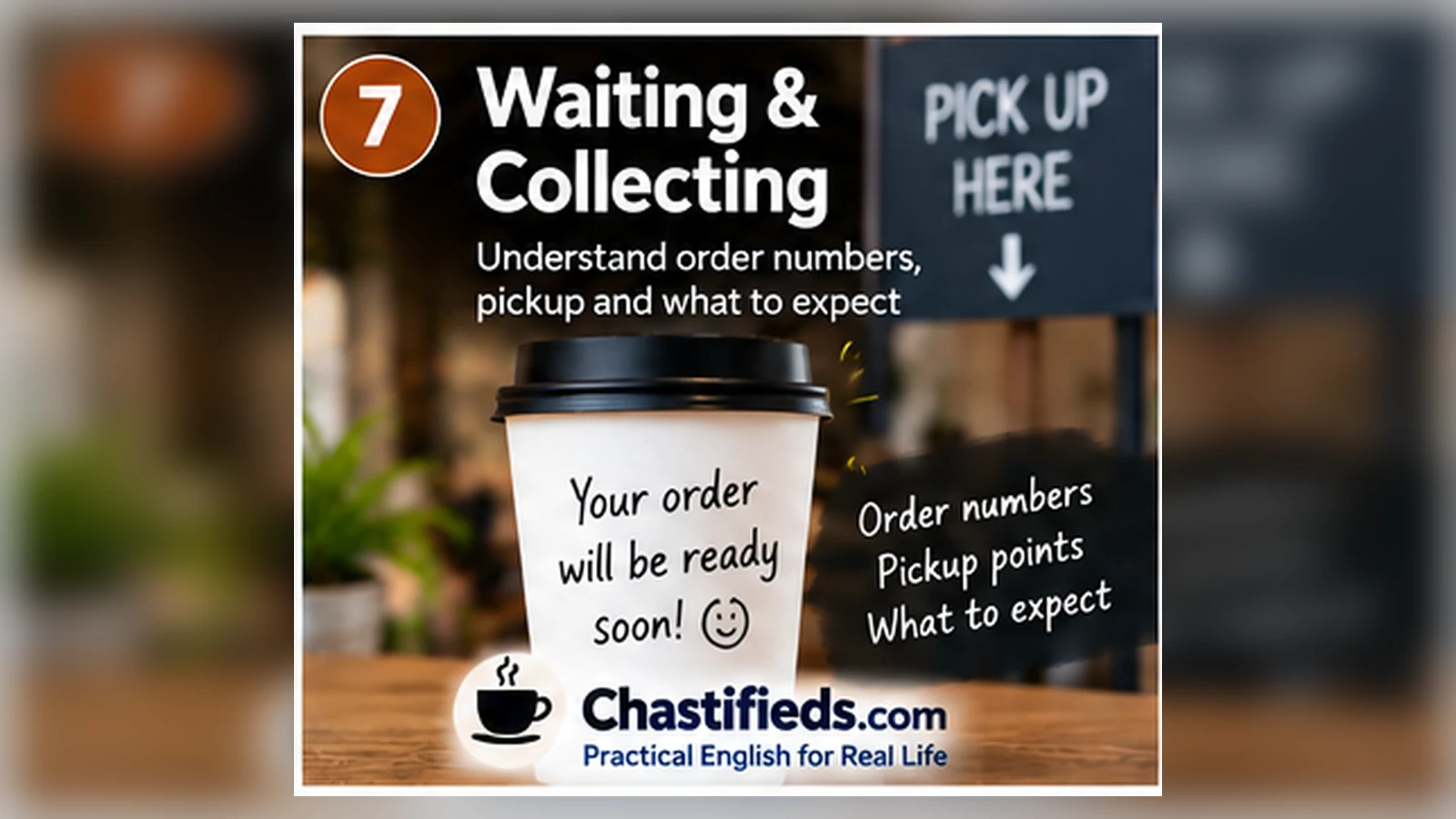
When your coffee is ready you may hear your name with the drink, such as "Flat white for Sam!". Look for signs such as "Pick up here", "Collection" or "Orders". If you miss the call, ask "Sorry, did you call my name?".
Understand the Australian context
After you order and pay, you usually wait near the pickup point. Staff may call your name, your order number or just the drink. Listen for the drink and the name together.
Some cafés give you a number or a table marker instead of calling a name. Others bring the food to your table. If you are not sure, ask "Is this where I collect?".
Before you take a drink, check that it is yours. "Is that the flat white?" is a quick question that avoids picking up the wrong order.
Key words and phrases
- pickup point
- The place where finished orders are collected.
- collection
- A sign for the pickup area.
- order number
- A number that identifies your order.
- call your name
- Say your name when the order is ready.
- on the counter
- Placed on the counter for collection.
- docket
- A printed or written order slip.
- table marker
- A number or sign placed on your table.
- ready
- Finished and available to collect.
Conversation practice: collecting your order
Barista: Flat white for Sam!
Sam: That is mine. Thanks!
Barista: Yep, flat white for Sam. Here you go.
Sam: Is that the large?
Barista: Yes, large. Enjoy!
Sam: Thanks. Where can I find the sugar?
Barista: Just down the end of the counter.
Sam: Great. Thanks very much.
Barista: No worries.
Sam: Sorry, was there a lid for that?
Barista: Yep, they are right here.
Sam: Thanks. Have a good one.
- The barista calls the drink and the name. Sam answers "That is mine".
- "Is that the large?" confirms the size before leaving.
- Sugar and lids are often at a side counter. Ask if you cannot see them.
More useful phrases
- That is mine. Thanks!
- This is my drink.Use it: Say this when your name is called.
- Is this where I collect?
- Is this the pickup point?Use it: Ask this if you are not sure.
- Sorry, did you call my name?
- Was that for me?Use it: Use this if you missed the call.
- Is that the flat white?
- Is that my drink?Use it: Check before you take it.
- Is my order ready yet?
- Has my drink been made?Use it: Ask this if you have waited a while.
- Where can I find the sugar?
- Where is the sugar?Use it: Ask this if you cannot see it.
- Could I have a lid, please?
- May I have a lid?Use it: Ask this for a takeaway cup.
- Thanks, have a good one.
- Thank you, and I hope your day goes well.Use it: A friendly way to leave.
- Sorry, could you say that again?
- Please repeat what you said.Use it: Use this when you miss a word.
Say it in a real conversation
Use these sentences in a real conversation. The replies you hear will change from place to place.
| When | You can say | It means |
|---|---|---|
| Say this when your name is called. | That is mine. Thanks! | This is my drink. |
| Ask this if you are not sure. | Is this where I collect? | Is this the pickup point? |
| Use this if you missed the call. | Sorry, did you call my name? | Was that for me? |
| Check before you take it. | Is that the flat white? | Is that my drink? |
| Ask this if you have waited a while. | Is my order ready yet? | Has my drink been made? |
| Ask this if you cannot see it. | Where can I find the sugar? | Where is the sugar? |
Listen for the key words in the reply and answer in a short, clear sentence.
Useful words at a glance
| Situation | What you may hear or see | What you can say |
|---|---|---|
| Listening for your name | “Sam?” / “Flat white for Sam!” | “Thanks!” |
| Finding the pickup point | “Pick up here”, “Collection”, “Orders” | “Is this where I collect?” |
| If you missed the call | The drink is on the counter | “Sorry, did you call my name?” |
Say it aloud: say this when your name is called
Saying a sentence out loud before you need it makes real conversations easier. Accents differ, so aim to be clear, not perfect.
- Slow. Read the sentence slowly, one phrase at a time.
- In full. Say: That is mine. Thanks!
- At normal speed. Say it again, as you would in a real conversation.
- Listen. Listen for the key words in the reply.
Practice 1: Role-play with a partner
Situation: You have ordered and are waiting. Listen for your name, check the drink and say thanks.
Work with a friend, a classmate or your mirror. One person is the sam. The other is barista. Read the lines, then cover the “You could say” answers and try it from memory. Swap roles.
sam: “Hi, how can I help?”
You could say:
- “Flat white for Sam!”
- “Is my order ready yet?”
sam: “That is mine. Thanks!”
You could say:
- “Yep, flat white for Sam. Here you go.”
- “Is that the flat white?”
sam: “Is that the large?”
You could say:
- “Yes, large. Enjoy!”
- “That is mine. Thanks!”
sam: “Thanks. Where can I find the sugar?”
You could say:
- “Just down the end of the counter.”
- “Where can I find the sugar?”
Challenge: Do the conversation again without looking at the lines, and change one detail.
Practice 2: Fill the gap
Say the missing word or phrase out loud before you open the answer.
Is this where I ___?
Show answer
collect — The phrase means: Is this the pickup point?
Is that the flat ___?
Show answer
white — The phrase means: Is that my drink?
Is my order ___ yet?
Show answer
ready — The phrase means: Has my drink been made?
Where can I find the ___?
Show answer
sugar — The phrase means: Where is the sugar?
The place where finished orders are collected. The word is ___.
Show answer
pickup point — "pickup point": The place where finished orders are collected.
A sign for the pickup area. The word is ___.
Show answer
collection — "collection": A sign for the pickup area.
Common mistakes and better ways to say it
Less helpful: “Taking the first coffee you see.”
Try instead: “Is that the flat white?”
Check the drink, the size and the name so you do not take someone else's order.
Less helpful: “Waiting in the wrong place.”
Try instead: “Is this where I collect?”
The pickup point may be at the end of the counter, not at the register.
Less helpful: “Complaining before you ask.”
Try instead: “Is my order ready yet?”
A polite question gets a clearer answer.
Less helpful: “Ignoring the name.”
Try instead: “Listen for the drink and the name together.”
In a busy café, both help you know the order is yours.
Wait near the pickup point
In many Australian cafés you order and pay at the counter, then wait nearby until your name or drink is called. Staff call out quickly, so stay close and listen.
Staff are used to customers who ask "Is that mine?". It is better to check than to take the wrong drink.
Advertisement
Real-life mission
Practise collecting an order.
You do not need to buy anything. Saying the sentences aloud is good practice.
Phrase Wall practice: phrases to own
Open a phrase to see it on the Phrase Wall, practise it, and save it to My Learning.
- “Sorry, did you call my name?”Was that for me?
- “That is mine. Thanks!”This is my drink.
- “Is this where I collect?”Is this the pickup point?