
What you need to know
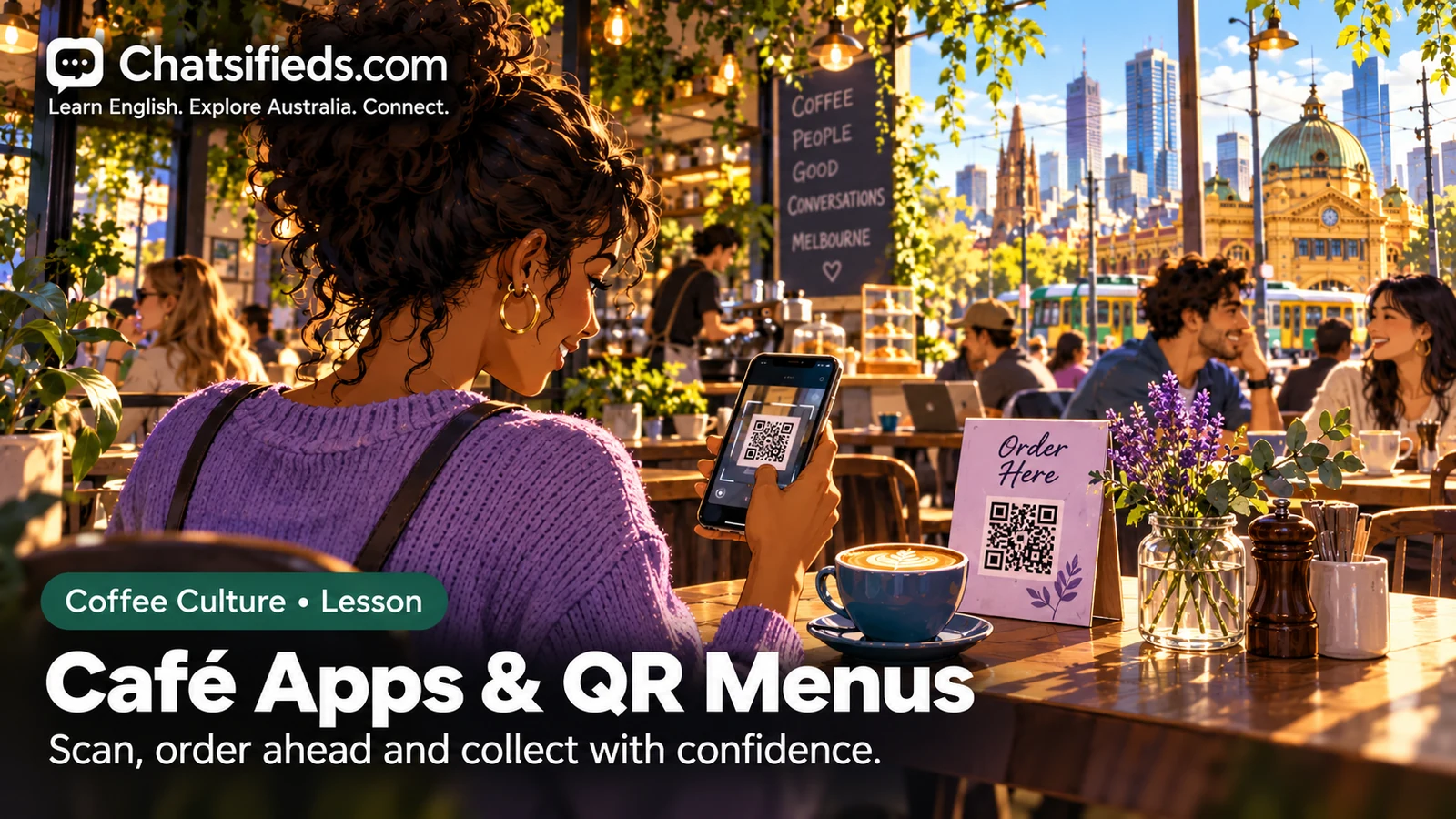
Scan the code, choose your items, and give your table number or order number when asked. If it is confusing, say "Could I have a paper menu, please?" Only scan codes from places you trust.
Understand the Australian context
Some cafés let you view a menu by scanning a QR code with your phone, order at your table, or order ahead online and collect your drink later. How this works depends on the café, so look at the signs or ask staff. Many cafés still have a counter or paper menu, so it is fine to ask.
For safety, the eSafety Commissioner says QR codes are usually safe and do not collect your personal information, but you should only scan codes from trusted sources. It warns that a sticker may be placed over a real sign or poster, and suggests checking that the link looks like the business you expect before you open it.
A CHOICE article, which quotes ACCC advice, adds that you should be careful with codes from unexpected places or pages that ask for passwords or camera access. It also suggests not downloading an app from a code, and finding it in an official app store instead. Scamwatch's general advice is to stop and check if something feels wrong, and not to give details if you are unsure.
Key words and phrases
- QR code
- a square pattern of dots that your phone camera can read to open a web page
- scan
- to point your phone camera at a code so it reads it
- order ahead
- to order before you arrive, using a website or app
- pick-up
- collecting your order from the café yourself
- collection
- the act of collecting something you ordered
- table number
- the number on your table, used so staff know where to bring your order
- order number
- a number given to your order so staff can find it
- paper menu
- a printed menu you can hold and read
Conversation practice: collecting an order placed online
Customer: Hi there. I ordered online for pick-up. Is it ready?
Staff: Sure, what name was it under?
Customer: It's under Sam. I think my order number is forty-two.
Staff: Let me check. Yep, here it is, a flat white and a toastie.
Customer: Thanks. Sorry, I think I ordered a large, but this looks regular.
Staff: Let me check the order on the screen. It says regular, so the online order might have been changed.
Customer: Ah, I see. Could I change it to a large, please?
Staff: No worries, I'll make a new one for you.
Customer: Thank you. Also, could I have a paper menu to check the sizes?
Staff: Of course, here you go.
Customer: Great, thanks for your help.
Staff: Any time. Your drink will be a few minutes.
- "What name was it under?" is a common way for staff to find your order. Have your name or order number ready.
- "Sorry, I think ..." is a gentle way to point out a problem without blaming anyone.
- Staff may fix a problem in different ways. Ask politely and be patient.
More useful phrases
- Could I have a paper menu, please?
- Can I read a printed menu instead?Use it: When the QR code does not work or you prefer paper.
- Could you help me with this code?
- I cannot make the QR code work.Use it: When your phone does not scan or the page will not load.
- I ordered online for pick-up.
- I made an order on a website or app and I am here to collect it.Use it: When you arrive to collect your order.
- My order number is forty-two.
- This is the number I was given.Use it: At the counter, when staff ask which order is yours.
- Which table number am I?
- What is the number of this table?Use it: When you sit down and cannot see a number.
- Sorry, I think there's a problem with my order.
- Something looks wrong.Use it: When an item is missing or different.
- Sorry, I can't get the menu to load. Could you help?
- Describing your problem gently gets help faster than blaming the café.Use it: Say this instead of "Your menu is not working.".
- Sorry, is my order ready yet? It's number forty-two.
- A full question with your order number helps staff find your order.Use it: Say this instead of "Where my coffee?".
Say it in a real conversation
Use these sentences in a real conversation. The replies you hear will change from place to place.
| When | You can say | It means |
|---|---|---|
| When the QR code does not work or you prefer paper. | Could I have a paper menu, please? | Can I read a printed menu instead? |
| When your phone does not scan or the page will not load. | Could you help me with this code? | I cannot make the QR code work. |
| When you arrive to collect your order. | I ordered online for pick-up. | I made an order on a website or app and I am here to collect it. |
| At the counter, when staff ask which order is yours. | My order number is forty-two. | This is the number I was given. |
| When you sit down and cannot see a number. | Which table number am I? | What is the number of this table? |
| When an item is missing or different. | Sorry, I think there's a problem with my order. | Something looks wrong. |
Listen for the key words in the reply and answer in a short, clear sentence.
Say it aloud: when the qr code does not work or you prefer paper
Saying a sentence out loud before you need it makes real conversations easier. Accents differ, so aim to be clear, not perfect.
- Slow. Read the sentence slowly, one phrase at a time.
- In full. Say: Could I have a paper menu, please?
- At normal speed. Say it again, as you would in a real conversation.
- Listen. Listen for the key words in the reply.
Practice 1: Role-play with a partner
Situation: Role-play collecting an online order. Tell the staff you ordered for pick-up, give your name and order number, and politely point out one small problem. Then ask for a paper menu.
Work with a friend, a classmate or your mirror. One person is the staff. The other is customer. Read the lines, then cover the “You could say” answers and try it from memory. Swap roles.
staff: “Hi, how can I help?”
You could say:
- “Hi there. I ordered online for pick-up. Is it ready?”
- “Sorry, I think there's a problem with my order.”
staff: “Sure, what name was it under?”
You could say:
- “It's under Sam. I think my order number is forty-two.”
- “Could I have a paper menu, please?”
staff: “Let me check. Yep, here it is, a flat white and a toastie.”
You could say:
- “Thanks. Sorry, I think I ordered a large, but this looks regular.”
- “Could you help me with this code?”
staff: “Let me check the order on the screen. It says regular, so the online order might have been changed.”
You could say:
- “Ah, I see. Could I change it to a large, please?”
- “I ordered online for pick-up.”
Challenge: Do the conversation again without looking at the lines, and change one detail.
Practice 2: Fill the gap
Say the missing word or phrase out loud before you open the answer.
Could I have a ___ menu, please?
Show answer
paper — The phrase means: Can I read a printed menu instead?
I ordered online for ___.
Show answer
pick-up — The phrase means: I made an order on a website or app and I am here to collect it.
My order number is ___.
Show answer
forty-two — The phrase means: This is the number I was given.
Which table ___ am I?
Show answer
number — The phrase means: What is the number of this table?
Sorry, I think there's a ___ with my order.
Show answer
problem — The phrase means: Something looks wrong.
Sorry, I ___ get the menu to load. Could you help?
Show answer
can't — The phrase means: Describing your problem gently gets help faster than blaming the café.
Common mistakes and better ways to say it
Less helpful: “Your menu is not working.”
Try instead: “Sorry, I can't get the menu to load. Could you help?”
Describing your problem gently gets help faster than blaming the café.
Less helpful: “I order from phone.”
Try instead: “I ordered online for pick-up.”
Use the past tense and the café phrase 'pick-up' so staff understand.
Less helpful: “Give me paper.”
Try instead: “Could I have a paper menu, please?”
Naming the item and adding please sounds polite and clear.
Less helpful: “Where my coffee?”
Try instead: “Sorry, is my order ready yet? It's number forty-two.”
A full question with your order number helps staff find your order.
Asking for help is normal
Many cafés mix technology and old-fashioned service. You might scan a code at one café and order at the counter at the next. Staff are used to questions about how things work, so asking for help is normal, not embarrassing.
If you are unsure about a code, you can simply order at the counter instead. Look at the sign and the table around the code, and ask staff if anything looks odd. Cafés also differ in how they handle online orders, so listen to what staff tell you and ask them to repeat if needed. Do not give extra personal details unless they seem necessary.
Advertisement
Real-life mission
Practise this lesson in real life.
You do not need to buy anything. Saying the sentences aloud is good practice.
Phrase Wall practice: phrases to own
Open a phrase to see it on the Phrase Wall, practise it, and save it to My Learning.
- “I ordered online for pick-up.”I made an order on a website or app and I am here to collect it.
- “Could I have a paper menu, please?”Can I read a printed menu instead?
- “Could you help me with this code?”I cannot make the QR code work.