
What you need to know
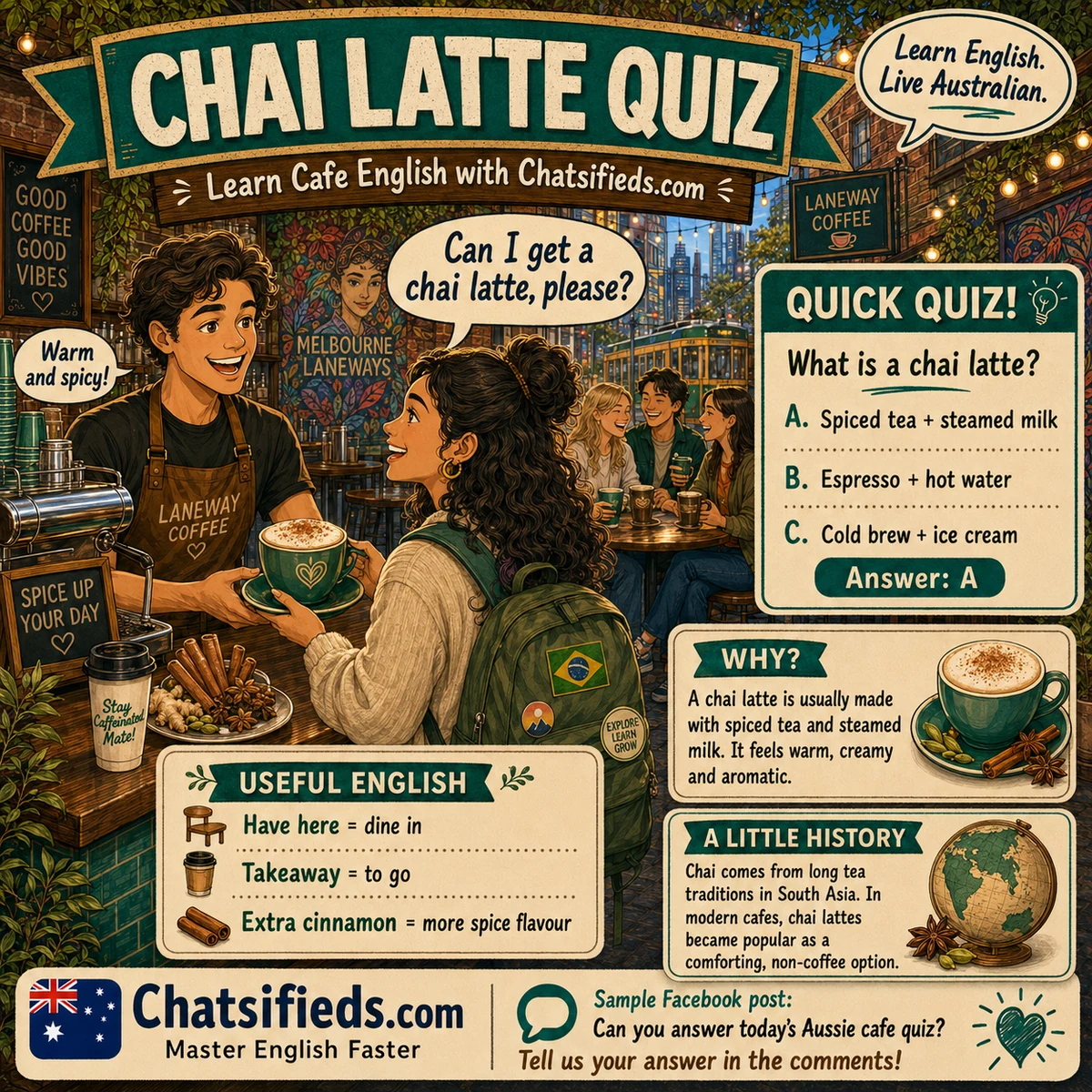
A chai latte is usually a spiced tea drink with steamed milk. In most cafés it is not coffee, even though the word latte means milk drink.
Understand the Australian context
Chai latte is helpful for English learners because it teaches that some café drinks sound like coffee but may not contain coffee. It also helps practise questions like “Does it have coffee in it?”
A chai latte is a warm spiced milk drink made with chai powder, syrup or tea concentrate. It usually does not contain coffee unless you ask for a dirty chai.
A chai latte is a spiced tea drink made with steamed milk, similar to a caffè latte. It uses a spiced tea mix instead of espresso, so it does not usually contain coffee.
Some cafés add a shot of espresso if you ask. That is called a dirty chai. The question "Does it have coffee in it?" is polite and useful.
A good sentence to practise is: “Could I please get a chai latte?” This sounds polite, clear and natural at the counter. You can add “to take away”, “to have here”, “with oat milk”, “regular”, “large”, or “extra hot” after the drink name.
Key words and phrases
- chai
- A spiced tea. In English the word often means the spiced milky drink.
- spiced
- Made with spices such as cinnamon or ginger.
- concentrate
- A strong liquid that is mixed with milk to make the drink.
- dirty chai
- A chai latte with a shot of espresso added.
- Can I grab...?
- A casual way to order. “Can I grab a latte?” means “Can I have a latte?”
- No worries
- A friendly Australian reply. It can mean “that's okay”, “sure”, or “you're welcome”.
- Takeaway
- Coffee you carry with you. In Australia this is more common than saying “to go”.
- Cheers
- A casual “thanks”. Students can still use “thank you” if they want to sound more formal.
- flat white
- Espresso with steamed milk and thin microfoam.
- long black
- Espresso poured over hot water.
- cappuccino
- Espresso with steamed milk, thicker foam and often chocolate powder.
Conversation practice: ordering a chai latte
Customer: Could I get a chai latte, please?
Barista: Sure. Would you like it regular or large?
Customer: Regular, thanks.
Barista: Here or takeaway?
Customer: Takeaway, thanks.
Barista: No worries. What name was that?
Customer: Paul. Thanks!
Barista: Cash or card?
Customer: Card, thanks.
Barista: Great. It will be a couple of minutes.
Customer: No worries. Cheers!
Barista: Have a good one.
- "Can I grab...?" and "Could I get...?" are both friendly ways to order. Add "please" or "thanks".
- "Takeaway" means you will carry the drink away. "Here" means you will stay in the café.
- "No worries" is a very common reply. It can mean "that is fine" or "sure".
More useful phrases
- Could I please get a chai latte?
- I would like a chai latte.Use it: A polite full order.
- Does the chai latte have coffee in it?
- Is there any coffee in this drink?Use it: Ask this if you are not sure. It is a useful question.
- Could I get a chai latte to take away?
- I would like a chai latte in a cup to carry.Use it: Say this if you are not staying in the café.
- To have here, thanks.
- I will drink it inside the café.Use it: Answer to "Here or takeaway?".
- Can I have that with oat milk, please?
- Please add this to my order.Use it: Say this to ask for milk, water or another change.
- Sorry, could you say that again?
- Please repeat what you said.Use it: Use this when you miss a word. It is polite and normal.
- What is the difference between a chai latte and a latte?
- Please explain how chai latte and latte are different.Use it: Ask this when you are not sure what to order.
- Regular, please.
- The standard size, please.Use it: Answer to "Regular or large?".
- Thanks, have a good one.
- Thank you, and I hope your day goes well.Use it: A friendly way to finish at the counter.
Say it in a real conversation
Use these sentences in a real conversation. The replies you hear will change from place to place.
| When | You can say | It means |
|---|---|---|
| A polite full order. | Could I please get a chai latte? | I would like a chai latte. |
| Ask this if you are not sure. It is a useful question. | Does the chai latte have coffee in it? | Is there any coffee in this drink? |
| Say this if you are not staying in the café. | Could I get a chai latte to take away? | I would like a chai latte in a cup to carry. |
| Answer to "Here or takeaway?". | To have here, thanks. | I will drink it inside the café. |
| Say this to ask for milk, water or another change. | Can I have that with oat milk, please? | Please add this to my order. |
| Use this when you miss a word. It is polite and normal. | Sorry, could you say that again? | Please repeat what you said. |
Listen for the key words in the reply and answer in a short, clear sentence.
Practise the sound of "chai latte"
Saying a word out loud before you need it makes ordering easier. Accents differ, so aim to be clear, not perfect.
- Slow. Say the drink name on its own, one syllable at a time, then smoothly.
- In a sentence. Say: Could I get a chai latte, please?
- At normal speed. Say the same sentence quickly, as you would at a busy counter.
- Listen. Listen for a question about size or milk. Repeat how the staff member says the drink name and notice any difference.
Optional: record yourself on your phone, listen back and say it once more.
Common variations you may hear
Add these words after the drink name to change the size, milk, strength or temperature.
- chai latte
- iced chai latte
- dirty chai
- oat chai latte
- skinny chai latte
Say it aloud: a polite full order
Saying a sentence out loud before you need it makes real conversations easier. Accents differ, so aim to be clear, not perfect.
- Slow. Read the sentence slowly, one phrase at a time.
- In full. Say: Could I please get a chai latte?
- At normal speed. Say it again, as you would in a real conversation.
- Listen. Listen for the key words in the reply.
Practice 1: Role-play with a partner
Situation: You are at the counter of an Australian café and you want a chai latte. Reply to the barista.
Work with a friend, a classmate or your mirror. One person is the barista. The other is customer. Read the lines, then cover the “You could say” answers and try it from memory. Swap roles.
barista: “Hi, how can I help?”
You could say:
- “Could I get a chai latte, please?”
- “Does the chai latte have coffee in it?”
barista: “Sure. Would you like it regular or large?”
You could say:
- “Regular, thanks.”
- “Large, please.”
barista: “Here or takeaway?”
You could say:
- “Takeaway, thanks.”
- “To have here, thanks.”
barista: “Cash or card?”
You could say:
- “Card, thanks.”
- “Cash, thanks.”
Challenge: Do the conversation again without looking at the lines, and change one detail.
Practice 2: Fill the gap
Say the missing word or phrase out loud before you open the answer.
Could I ___ a chai latte, please?
Show answer
get — "Could I get...?" is a polite way to order.
Can I ___ a chai latte, please?
Show answer
grab — "Can I grab...?" is a casual, friendly way to order.
Could I get a chai latte to take ___?
Show answer
away — "To take away" means you will carry the drink with you.
Sorry, could you say that ___?
Show answer
again — Use this to ask someone to repeat what they said.
___ or large? (The standard size)
Show answer
Regular — "Regular" is the standard cup size.
A friendly Australian reply is "No ___."
Show answer
worries — "No worries" can mean "that is fine" or "you are welcome".
Common mistakes and better ways to say it
Less helpful: “Chai coffee.”
Try instead: “Could I get a chai latte, please?”
A chai latte is a tea drink. "Chai coffee" can confuse the barista, because the drink does not usually contain coffee.
Less helpful: “Tea with milk.”
Try instead: “Could I get a chai latte, please?”
"Tea with milk" is a different order. Say "chai latte" if you want the spiced drink.
Less helpful: “Chai latte.”
Try instead: “Could I get a chai latte, please?”
Adding "Could I get" and "please" is friendlier than a single word, and it takes only a second.
Less helpful: “To go.”
Try instead: “Takeaway, thanks.”
"Takeaway" is the usual Australian word. Staff will understand "to go", but "takeaway" sounds more local.
Not every latte is coffee
Chai latte teaches a useful lesson: a drink name can sound like coffee but not be coffee. Reading the menu line carefully helps you avoid surprises, especially if you avoid caffeine.
If you want coffee in it, ask politely for a dirty chai. Café staff hear this order often and will tell you how they make it.
Advertisement
Real-life mission
Practise a chai latte in real life.
You do not need to buy anything. Saying the sentences aloud is good practice.
Phrase Wall practice: phrases to own
Open a phrase to see it on the Phrase Wall, practise it, and save it to My Learning.
- “Could I get a chai latte, please?”I would like a chai latte.
- “Could I please get a chai latte?”I would like a chai latte.
- “Does the chai latte have coffee in it?”Is there any coffee in this drink?