
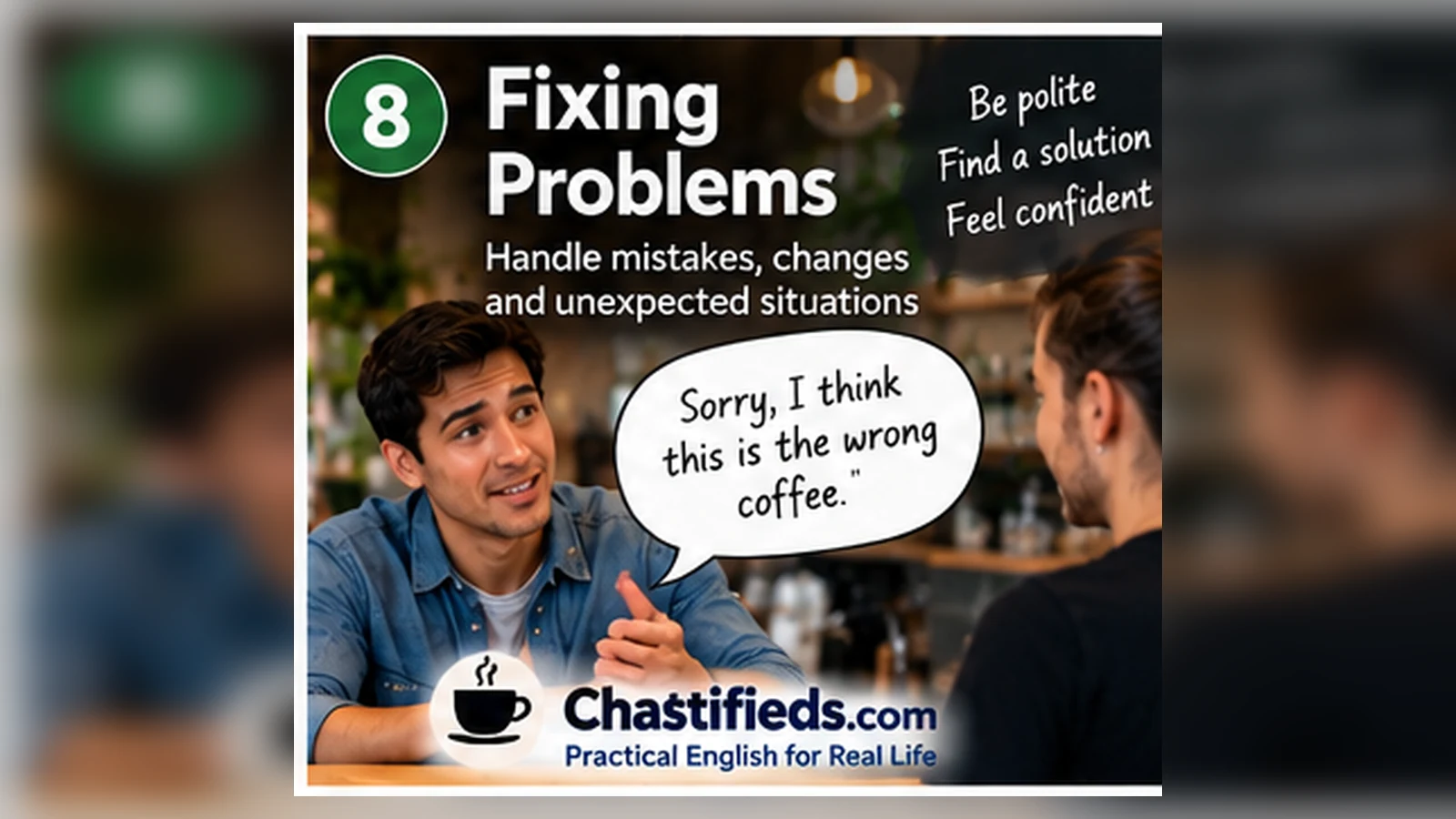
What you need to know
Use polite complete sentences instead of very short direct orders. Instead of "Give me coffee", say "Could I get a coffee, please?".
Understand the Australian context
The goal is not perfect grammar. The goal is clear, friendly and useful English in a real café. Short, bare orders such as "Give me coffee" can sound rude even when you do not mean it.
Australian café English is usually casual, but politeness still matters. Please, thanks and a friendly tone help the order sound natural, and a short complete sentence is easy for staff to follow.
Most mistakes are easy to fix with a small set of phrases: "Could I get...?", "Takeaway, thanks.", "Could I get that with oat milk?" and "Sorry, could you say that again?". Practise these and the rest follows.
Key words and phrases
- direct order
- A very short request that sounds like a command.
- polite request
- A question or phrase that asks politely, such as "Could I get...?".
- natural
- Sounding like something a local would say.
- awkward
- Sounding strange or uncomfortable.
- please
- The word that makes a request polite.
- thanks
- A friendly, short way to say thank you.
- takeaway
- Coffee you take with you.
- repeat
- Say something again.
Conversation practice: fixing a rude-sounding order
Customer: Give me a coffee.
Barista: Sorry, what would you like?
Customer: Oh, sorry. Could I get a coffee, please?
Barista: Sure. What kind?
Customer: A flat white, please.
Barista: Regular or large?
Customer: Large, please. And could I get that with oat milk?
Barista: No worries. Having here or takeaway?
Customer: Takeaway, thanks.
Barista: Great. What name was that?
Customer: Paul. Thanks!
Barista: Thanks, Paul. Have a good one.
- The customer fixes the order by starting again politely. Staff do not mind, and it is a good habit.
- "Could I get...?" and "please" turn a command into a polite request.
- "What kind?" asks you to choose a drink. Name the drink to answer.
More useful phrases
- Could I get a coffee, please?
- I would like a coffee.Use it: Use this instead of "Give me coffee".
- Could I get a mocha, please?
- I would like a mocha.Use it: Use this instead of "Mocha now".
- Takeaway, thanks.
- I will take it with me.Use it: Use this instead of "Go out coffee".
- Sorry, could you say that again?
- Please repeat what you said.Use it: Use this instead of silence.
- Could I get that with oat milk, please?
- I would like oat milk in my drink.Use it: Use this instead of "I want milk change".
- Could I get a large coffee, please?
- I would like a big coffee.Use it: Use this instead of "Big coffee".
- Could I start again?
- Can I say my order again?Use it: Use this if you want to fix your order.
- Sorry, I mean a flat white.
- I want to correct my order.Use it: Use this to correct yourself politely.
- Thanks, that is perfect.
- That is exactly what I wanted.Use it: A friendly reply when the drink arrives.
Say it in a real conversation
Use these sentences in a real conversation. The replies you hear will change from place to place.
| When | You can say | It means |
|---|---|---|
| Use this instead of "Give me coffee". | Could I get a coffee, please? | I would like a coffee. |
| Use this instead of "Mocha now". | Could I get a mocha, please? | I would like a mocha. |
| Use this instead of "Go out coffee". | Takeaway, thanks. | I will take it with me. |
| Use this instead of silence. | Sorry, could you say that again? | Please repeat what you said. |
| Use this instead of "I want milk change". | Could I get that with oat milk, please? | I would like oat milk in my drink. |
| Use this instead of "Big coffee". | Could I get a large coffee, please? | I would like a big coffee. |
Listen for the key words in the reply and answer in a short, clear sentence.
Instead of this, say this
| Instead of | Say |
|---|---|
| Give me coffee | Could I get a coffee, please? |
| Mocha now | Could I get a mocha, please? |
| Go out coffee | Takeaway, thanks. |
| (silence) | Sorry, could you say that again? |
| I want milk change | Could I get that with oat milk, please? |
| Big coffee | Could I get a large coffee, please? |
The goal is not perfect grammar. The goal is clear, friendly and useful English in a real café.
Say it aloud: use this instead of "give me coffee"
Saying a sentence out loud before you need it makes real conversations easier. Accents differ, so aim to be clear, not perfect.
- Slow. Read the sentence slowly, one phrase at a time.
- In full. Say: Could I get a coffee, please?
- At normal speed. Say it again, as you would in a real conversation.
- Listen. Listen for the key words in the reply.
Practice 1: Role-play with a partner
Situation: You said "Give me a coffee" and the barista looked surprised. Fix your order politely.
Work with a friend, a classmate or your mirror. One person is the barista. The other is customer. Read the lines, then cover the “You could say” answers and try it from memory. Swap roles.
barista: “Hi, how can I help?”
You could say:
- “Give me a coffee.”
- “Could I get a large coffee, please?”
barista: “Sorry, what would you like?”
You could say:
- “Oh, sorry. Could I get a coffee, please?”
- “Could I get a coffee, please?”
barista: “Sure. What kind?”
You could say:
- “A flat white, please.”
- “Sorry, I mean a flat white.”
barista: “Regular or large?”
You could say:
- “Large, please. And could I get that with oat milk?”
- “Could I get that with oat milk, please?”
Challenge: Do the conversation again without looking at the lines, and change one detail.
Practice 2: Fill the gap
Say the missing word or phrase out loud before you open the answer.
Could I get a ___, please?
Show answer
coffee — The phrase means: I would like a coffee.
Could I get a ___, please?
Show answer
mocha — The phrase means: I would like a mocha.
Could I get a large ___, please?
Show answer
coffee — The phrase means: I would like a big coffee.
Could I ___ again?
Show answer
start — The phrase means: Can I say my order again?
Sorry, I mean a flat ___.
Show answer
white — The phrase means: I want to correct my order.
Thanks, that is ___.
Show answer
perfect — The phrase means: That is exactly what I wanted.
Common mistakes and better ways to say it
Less helpful: “Give me coffee.”
Try instead: “Could I get a coffee, please?”
"Could I get...?" and "please" sound polite, while a command can sound rude.
Less helpful: “Mocha now.”
Try instead: “Could I get a mocha, please?”
A full sentence is friendlier than a drink name and a time word.
Less helpful: “Go out coffee.”
Try instead: “Takeaway, thanks.”
"Takeaway" is the usual word for coffee you take with you.
Less helpful: “I want milk change.”
Try instead: “Could I get that with oat milk, please?”
Say which milk you want. "Change" does not say what you want.
Less helpful: “Big coffee.”
Try instead: “Could I get a large coffee, please?”
"Large" is the size word staff expect.
Polite does not mean perfect
Australian cafés are casual, so you do not need very formal English. A friendly tone, "please" and "thanks" are the main things. A small mistake in grammar is usually not a problem.
If your first sentence sounds blunt, you can simply start again. Staff understand, and many learners do the same. What matters is that the conversation stays friendly.
Advertisement
Real-life mission
Practise replacing common mistakes.
You do not need to buy anything. Saying the sentences aloud is good practice.
Phrase Wall practice: phrases to own
Open a phrase to see it on the Phrase Wall, practise it, and save it to My Learning.
- “Could I get that with oat milk, please?”I would like oat milk in my drink.
- “Could I get a large coffee, please?”I would like a big coffee.
- “Could I start again?”Can I say my order again?