
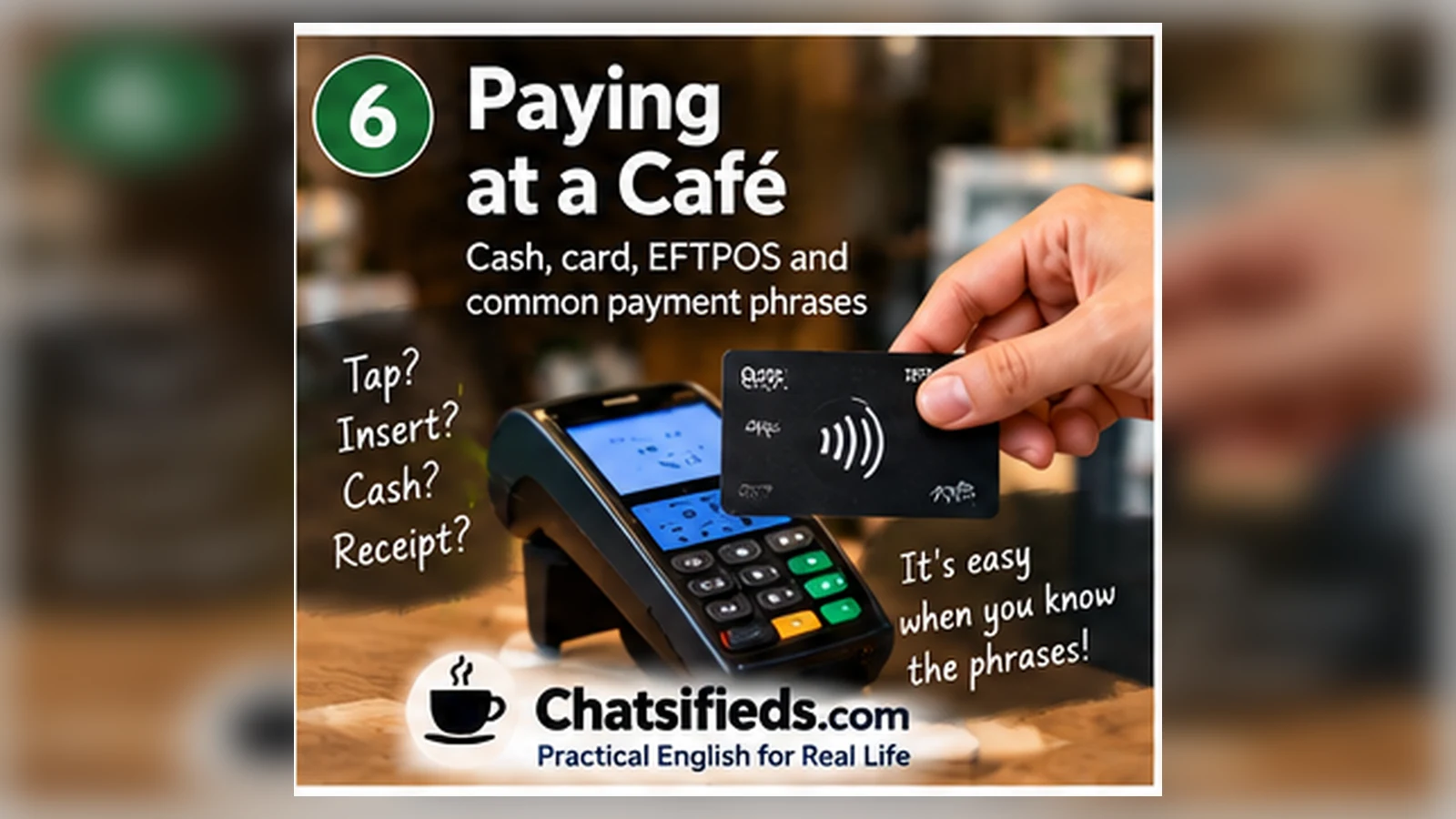
What you need to know
Use simple phrases: "Card, thanks.", "Can I tap?" or "Could I get a receipt?". Since 1 October 2026, cafés cannot add a surcharge for paying with Visa, Mastercard, American Express or eftpos cards.
Understand the Australian context
Card and tap payments are common in Australian cafés. "Tap" means paying by touching your card or phone on the machine. Many people tap for even a single coffee.
The word "surcharge" used to appear on café signs for card payments. The ACCC says that from 1 October 2026 businesses can no longer add a surcharge for payments made with Visa, Mastercard, American Express and eftpos cards. Businesses can still raise their prices, but they must not mislead customers about them.
Other surcharges are not affected. Hospitality businesses can still charge a weekend or public holiday surcharge, so you may still see the word on a menu. If you are unsure, ask "Is there a surcharge today?" before you order.
Key words and phrases
- card
- A debit or credit card.
- tap
- Pay by touching your card or phone on the machine.
- cash
- Notes and coins.
- receipt
- The paper or email that shows what you paid.
- surcharge
- An extra fee added to the price. Card surcharges are banned from 1 October 2026; weekend and public holiday surcharges can still apply.
- EFTPOS
- A common debit card system in Australia.
- total
- The full amount you pay.
- change
- The money given back when you pay more than the price.
Conversation practice: paying at the counter
Barista: That will be five dollars. Cash or card?
Customer: Card, thanks. Can I tap?
Barista: Yep, you can tap when you are ready.
Customer: Done. Could I get a receipt, please?
Barista: Sure. Paper or email?
Customer: Email is fine, thanks.
Barista: No worries. What name was that for the order?
Customer: Paul.
Customer: Sorry, is there a weekend surcharge today?
Barista: Yes, it is a Sunday, so there is a surcharge on the whole bill. It is on the menu board.
Customer: Okay, thanks for telling me.
Barista: No worries. Have a good one.
- "Can I tap?" asks whether you can pay by touching your card or phone.
- "Paper or email?" asks how you want your receipt.
- A weekend or public holiday surcharge is a different thing from a card surcharge. Look for it on the menu or ask.
More useful phrases
- Card, thanks.
- I will pay by card.Use it: Answer to "Cash or card?".
- Can I tap?
- Can I pay by touching my card or phone?Use it: Ask this when you are ready to pay.
- Cash, thanks.
- I will pay with cash.Use it: Use this if you are paying with notes and coins.
- Could I get a receipt, please?
- I would like proof of payment.Use it: Ask for this after you pay.
- Is there a surcharge today?
- Is there an extra fee today?Use it: Ask this about weekend or public holiday prices.
- That is all, thank you.
- I do not want anything else.Use it: Finish your order politely.
- Sorry, could you say that again?
- Please repeat the amount or question.Use it: Use this when you miss a number.
- How much is that?
- What is the total?Use it: Ask this if you did not hear the price.
- Could I split this, please?
- Can we pay separately?Use it: Ask this when you pay with friends.
Say it in a real conversation
Use these sentences in a real conversation. The replies you hear will change from place to place.
| When | You can say | It means |
|---|---|---|
| Answer to "Cash or card?". | Card, thanks. | I will pay by card. |
| Ask this when you are ready to pay. | Can I tap? | Can I pay by touching my card or phone? |
| Use this if you are paying with notes and coins. | Cash, thanks. | I will pay with cash. |
| Ask for this after you pay. | Could I get a receipt, please? | I would like proof of payment. |
| Ask this about weekend or public holiday prices. | Is there a surcharge today? | Is there an extra fee today? |
| Finish your order politely. | That is all, thank you. | I do not want anything else. |
Listen for the key words in the reply and answer in a short, clear sentence.
Card surcharges and other surcharges
The ACCC says card surcharges on Visa, Mastercard, American Express and eftpos payments have been banned since 1 October 2026. The ban does not cover surcharges that are unrelated to how you pay, such as weekend or public holiday surcharges in hospitality.
Businesses can still show different prices for different payment methods if they disclose them clearly, so read the menu and the sign at the counter.
Say it aloud: answer to "cash or card?"
Saying a sentence out loud before you need it makes real conversations easier. Accents differ, so aim to be clear, not perfect.
- Slow. Read the sentence slowly, one phrase at a time.
- In full. Say: Card, thanks.
- At normal speed. Say it again, as you would in a real conversation.
- Listen. Listen for the key words in the reply.
Practice 1: Role-play with a partner
Situation: You have ordered a coffee. The barista asks how you want to pay.
Work with a friend, a classmate or your mirror. One person is the barista. The other is customer. Read the lines, then cover the “You could say” answers and try it from memory. Swap roles.
barista: “That will be five dollars. Cash or card?”
You could say:
- “Card, thanks.”
- “Cash, thanks.”
barista: “You can tap when you are ready.”
You could say:
- “Can I tap?”
- “Done. Thanks.”
barista: “Would you like a receipt?”
You could say:
- “Could I get a receipt, please?”
- “No, that is all, thank you.”
barista: “Is there anything else?”
You could say:
- “That is all, thank you.”
- “Sorry, could you say that again?”
Challenge: Do the conversation again without looking at the lines, and change one detail.
Practice 2: Fill the gap
Say the missing word or phrase out loud before you open the answer.
Could I get a ___, please?
Show answer
receipt — The phrase means: I would like proof of payment.
Is there a ___ today?
Show answer
surcharge — The phrase means: Is there an extra fee today?
Could I ___ this, please?
Show answer
split — The phrase means: Can we pay separately?
A debit or credit card. The word is ___.
Show answer
card — "card": A debit or credit card.
Pay by touching your card or phone on the machine. The word is ___.
Show answer
tap — "tap": Pay by touching your card or phone on the machine.
Notes and coins. The word is ___.
Show answer
cash — "cash": Notes and coins.
Common mistakes and better ways to say it
Less helpful: “Pay.”
Try instead: “Can I tap?”
A full question is clearer. "Can I tap?" tells staff you mean contactless payment.
Less helpful: “I have no cash, sorry.”
Try instead: “Card, thanks.”
You do not need to apologise. Card is a normal answer in most cafés.
Less helpful: “Why more money for card?”
Try instead: “Is there a surcharge today?”
Card surcharges are banned from 1 October 2026. If you are charged one, ask politely what it is for.
Less helpful: “Paper!”
Try instead: “Could I get a receipt, please?”
A full sentence with "please" is friendlier and clearer.
Paying is part of the conversation
Paying is often the last step of a café order, and staff ask about it quickly: "Cash or card?". A short answer and a thank you finish the order politely.
Tipping is not generally expected in Australia, although you can choose to leave one. A tip jar or a prompt on the payment screen does not make it compulsory.
Advertisement
Real-life mission
Practise paying in real life.
You do not need to buy anything. Saying the sentences aloud is good practice.
Phrase Wall practice: phrases to own
Open a phrase to see it on the Phrase Wall, practise it, and save it to My Learning.
- “Can I tap?”Can I pay by touching my card or phone?
- “Is there a surcharge today?”Is there an extra fee today?
- “That is all, thank you.”I do not want anything else.