
What you need to know
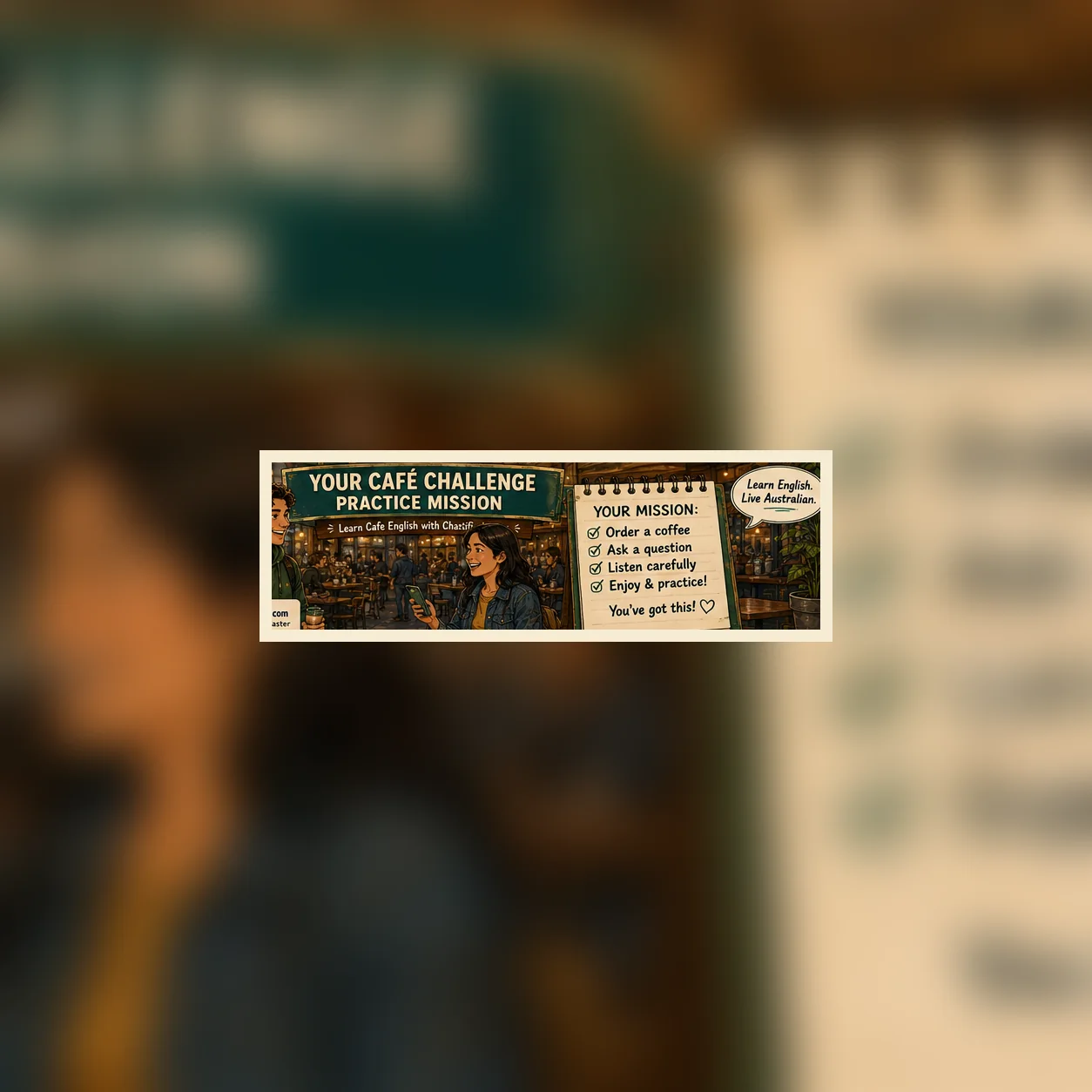
This seven-day challenge uses repetition, not one big test. Each day adds one small skill: read the menu, say an order, recognise barista questions, order in person, ask for clarification, add food and reflect. Seven is a structure, not a deadline.
Understand the Australian context
The challenge moves from private practice to real interaction: read the menu, say an order aloud, recognise barista questions, order in person, ask one clarification, add food, then reflect on the complete visit. Confidence grows from successful repetition. It does not require speaking without an accent or understanding every word.
You can repeat days or take longer than a week. The number seven is a useful structure, not a deadline. If you do not drink coffee, use tea, chai, hot chocolate or another café item. The language skills are the same.
Daily plan: Day 1 read one menu. Day 2 say your order aloud. Day 3 listen for follow-up questions such as "What milk was that?" Day 4 place the order yourself. Day 5 ask for clarification: "Sorry, could you say that again?" Day 6 add a food item: "Anything else?". Day 7 reflect, and practise "Name for the order?".
Key words and phrases
- challenge
- A task that tests and builds a skill.
- repetition
- Doing something again and again.
- confidence
- Feeling able to do something.
- follow-up question
- A question after your first request.
- clarification
- Making something clear.
- reflect
- Think about what happened.
- quieter time
- A time when fewer people are there.
- small step
- A short, manageable task.
Conversation practice: Day 4, placing the order
Customer: Hi, could I get a flat white, please?
Barista: Sure. What milk?
Customer: Regular milk, thanks.
Barista: Anything else?
Customer: Could I add a banana bread, please?
Barista: No worries. Takeaway or here?
Customer: For here, please.
Barista: Name for the order?
Customer: Lin.
Barista: Thanks, Lin. That is $9.50.
Customer: Sorry, could you say that again?
Barista: Nine fifty. You can tap here.
- The customer adds food in a short, polite request.
- "Sorry, could you say that again?" is the Day 5 skill used naturally.
- "Name for the order?" is common and needs only your name.
More useful phrases
- What milk was that?
- Which milk do you want?Use it: Day 3 listening.
- Anything else?
- Do you want more?Use it: Day 6 adding food.
- Name for the order?
- What name should I write?Use it: Day 4 or 7 real interaction.
- Sorry, could you say that again?
- Please repeat.Use it: Day 5 clarification.
- Could I add a banana bread, please?
- I would like to add food.Use it: Add a food item.
- Could I have a quiet table?
- A less busy place to sit.Use it: A comfortable choice.
- Sorry, what does that mean?
- Please explain the word.Use it: Ask instead of guessing.
- I am practising my English.
- I am learning.Use it: A friendly explanation.
- Thanks, have a good one.
- Thank you, and I hope your day goes well.Use it: A friendly way to finish.
Say it in a real conversation
Use these sentences in a real conversation. The replies you hear will change from place to place.
| When | You can say | It means |
|---|---|---|
| Day 3 listening. | What milk was that? | Which milk do you want? |
| Day 6 adding food. | Anything else? | Do you want more? |
| Day 4 or 7 real interaction. | Name for the order? | What name should I write? |
| Day 5 clarification. | Sorry, could you say that again? | Please repeat. |
| Add a food item. | Could I add a banana bread, please? | I would like to add food. |
| A comfortable choice. | Could I have a quiet table? | A less busy place to sit. |
Listen for the key words in the reply and answer in a short, clear sentence.
Track your seven days
Tap a day when you finish it. Your ticks stay on this device only. You can repeat a day or take longer than a week.
Say it aloud: day 3 listening
Saying a sentence out loud before you need it makes real conversations easier. Accents differ, so aim to be clear, not perfect.
- Slow. Read the sentence slowly, one phrase at a time.
- In full. Say: What milk was that?
- At normal speed. Say it again, as you would in a real conversation.
- Listen. Listen for the key words in the reply.
Practice 1: Role-play with a partner
Situation: You are on Day 4. Place the order yourself, add a food item and ask once if you miss something.
Work with a friend, a classmate or your mirror. One person is the barista. The other is customer. Read the lines, then cover the “You could say” answers and try it from memory. Swap roles.
barista: “Hi, how can I help?”
You could say:
- “Hi, could I get a flat white, please?”
- “Could I add a banana bread, please?”
barista: “Sure. What milk?”
You could say:
- “Regular milk, thanks.”
- “What milk was that?”
barista: “Anything else?”
You could say:
- “Could I add a banana bread, please?”
- “Could I have a quiet table?”
barista: “No worries. Takeaway or here?”
You could say:
- “For here, please.”
- “Name for the order?”
Challenge: Do the conversation again without looking at the lines, and change one detail.
Practice 2: Fill the gap
Say the missing word or phrase out loud before you open the answer.
Name for the ___?
Show answer
order — The phrase means: What name should I write?
Could I add a ___ bread, please?
Show answer
banana — The phrase means: I would like to add food.
Could I have a quiet ___?
Show answer
table — The phrase means: A less busy place to sit.
I am ___ my English.
Show answer
practising — The phrase means: I am learning.
A task that tests and builds a skill. The word is ___.
Show answer
challenge — "challenge": A task that tests and builds a skill.
Doing something again and again. The word is ___.
Show answer
repetition — "repetition": Doing something again and again.
Common mistakes and better ways to say it
Less helpful: “Treating seven days as a strict deadline.”
Try instead: “I will repeat the day.”
You can pause or repeat.
Less helpful: “Waiting until you understand every word.”
Try instead: “Sorry, could you say that again?”
Asking is a skill.
Less helpful: “Skipping the challenge because you do not drink coffee.”
Try instead: “Could I have a chai, please?”
Any café item works.
Less helpful: “Going at a busy time when nervous.”
Try instead: “Choose a quieter time.”
Keep the task small.
Small wins build confidence
One completed real-world task is worth more than reading ten lessons without using them. Do not rush ahead.
If you feel nervous, choose a quieter time and keep the task small. Staff meet many learners and nervous customers, and a polite short answer is welcome.
Advertisement
Real-life mission
Start with Day 1 today.
You do not need to buy anything. Saying the sentences aloud is good practice.
Phrase Wall practice: phrases to own
Open a phrase to see it on the Phrase Wall, practise it, and save it to My Learning.
- “Sorry, could you say that again?”Please repeat.
- “Could I add a banana bread, please?”I would like to add food.
- “Could I have a quiet table?”A less busy place to sit.