
What you need to know
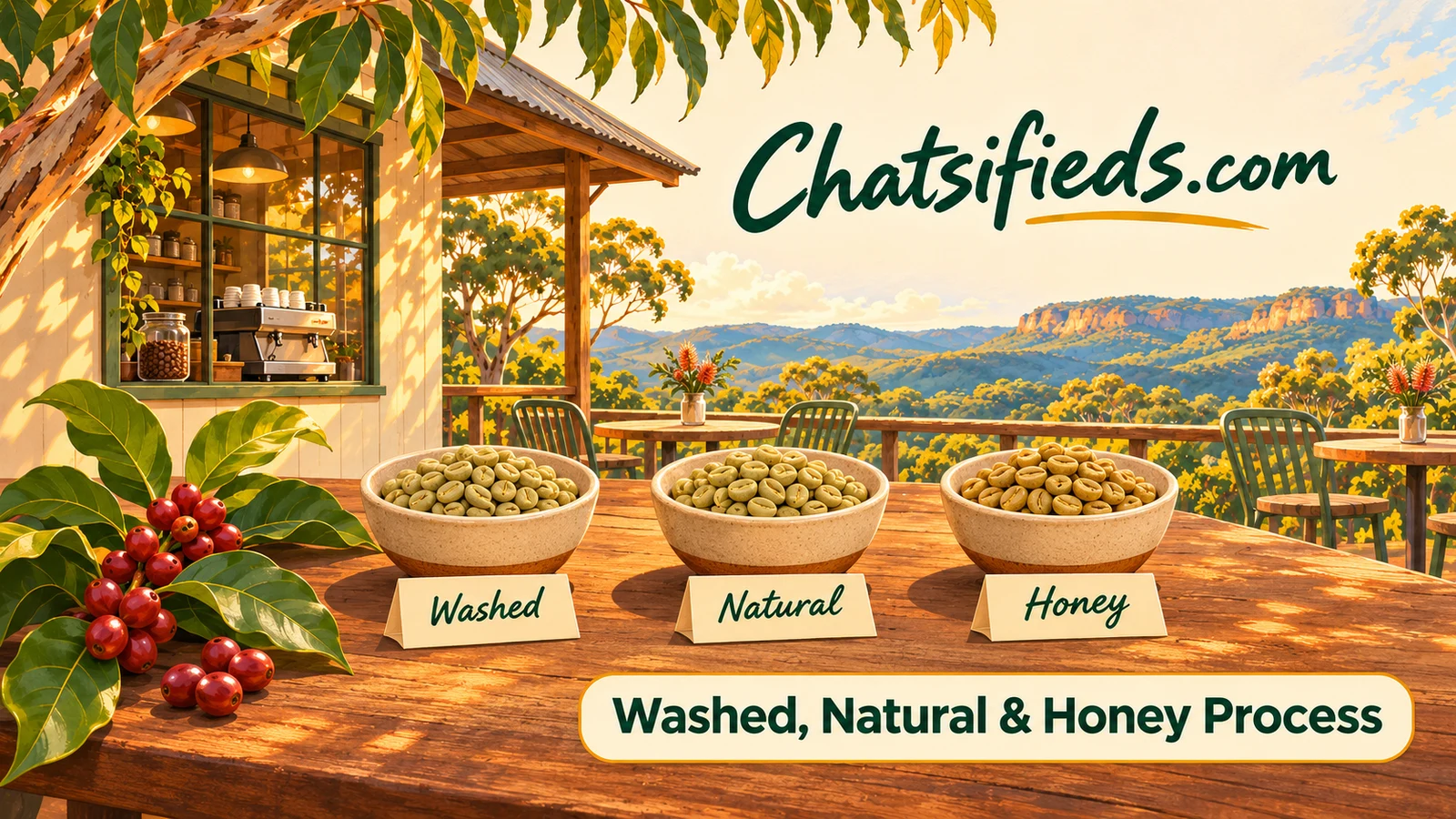
Washed, natural and honey are not added flavours. They describe how coffee fruit is handled after harvest. Natural dries with much of the fruit intact, washed removes fruit and mucilage before drying, and honey removes the skin but leaves some mucilage. Process can influence flavour but is never the only factor.
Understand the Australian context
What we call a coffee bean is a seed inside a coffee fruit. After harvest, producers separate and dry the seed so it can become stable green coffee for export and roasting. Processing names summarise parts of that journey.
In broad terms: natural processing dries the coffee with the fruit around the seed, washed processing removes the fruit and mucilage before drying after a wet-processing stage, and honey processing removes the skin while leaving some sticky mucilage during drying. "Honey" refers to the sticky layer, not added sweetener.
Shortcuts such as "natural equals fruity" and "washed equals clean" can be a starting point, but variety, ripeness, fermentation, drying, storage, roast and brewing all matter. Exact practices and terms vary by origin and producer.
Key words and phrases
- processing
- What is done to coffee fruit after harvest.
- washed
- Fruit and mucilage removed before drying.
- natural
- Dried with much of the fruit intact.
- honey process
- Skin removed, some mucilage left during drying.
- mucilage
- The sticky layer around the seed.
- cherry
- The coffee fruit.
- green coffee
- Unroasted coffee beans.
- producer
- The farmer or business that grows and processes coffee.
Conversation practice: asking about processing
Customer: Hi! Could you tell me about these two bags?
Barista: Sure. This one is washed, and this one is honey processed.
Customer: Sorry, what does honey process mean?
Barista: It means the skin is removed but some of the sticky layer stays on during drying.
Customer: So is there honey in it?
Barista: No, there is no honey added. It is just the name of the style.
Customer: What does that change in the flavour?
Barista: It can make the cup a little sweeter, but it depends on the farm and the roast.
Customer: How was the washed one processed?
Barista: Fruit and mucilage were removed before drying. It tends to taste cleaner, but not always.
Customer: Thanks. I will try the honey one.
Barista: Great, enjoy it!
- "So is there honey in it?" is a common question. The answer is no.
- "It depends on the farm and the roast" shows process is not a guarantee.
- The barista uses "tends to", which signals a pattern, not a rule.
More useful phrases
- How was this coffee processed?
- What process was used?Use it: A key question.
- Sorry, what does honey process mean?
- Please explain.Use it: Ask for an explanation.
- Is there honey in it?
- Was honey added?Use it: A common check.
- What does that change in the flavour?
- How does it affect the taste?Use it: Connect process to taste.
- Is it a washed or a natural?
- Which process is it?Use it: Ask directly.
- Does natural always taste fruity?
- Is that a rule?Use it: Test a shortcut.
- Could you recommend one for filter?
- Which suits filter?Use it: Ask for a suggestion.
- Sorry, could you say that again?
- Please repeat what you said.Use it: Use this when you miss a word.
- Thanks, have a good one.
- Thank you, and I hope your day goes well.Use it: A friendly way to finish.
Say it in a real conversation
Use these sentences in a real conversation. The replies you hear will change from place to place.
| When | You can say | It means |
|---|---|---|
| A key question. | How was this coffee processed? | What process was used? |
| Ask for an explanation. | Sorry, what does honey process mean? | Please explain. |
| A common check. | Is there honey in it? | Was honey added? |
| Connect process to taste. | What does that change in the flavour? | How does it affect the taste? |
| Ask directly. | Is it a washed or a natural? | Which process is it? |
| Test a shortcut. | Does natural always taste fruity? | Is that a rule? |
Listen for the key words in the reply and answer in a short, clear sentence.
Useful words at a glance
| Process | What happens | Do not confuse it with |
|---|---|---|
| Natural | Coffee dries with much of the fruit intact. | A flavoured coffee. |
| Washed | Fruit and mucilage are removed, after a wet-processing stage, before drying. | A cleaner or weaker coffee. |
| Honey | The skin is removed but some mucilage stays on the coffee during drying. | Added honey or sweetener. |
Say it aloud: a key question
Saying a sentence out loud before you need it makes real conversations easier. Accents differ, so aim to be clear, not perfect.
- Slow. Read the sentence slowly, one phrase at a time.
- In full. Say: How was this coffee processed?
- At normal speed. Say it again, as you would in a real conversation.
- Listen. Listen for the key words in the reply.
Practice 1: Role-play with a partner
Situation: You are choosing between a washed and a honey processed coffee. Ask what honey process means and whether honey is added.
Work with a friend, a classmate or your mirror. One person is the barista. The other is customer. Read the lines, then cover the “You could say” answers and try it from memory. Swap roles.
barista: “Hi, how can I help?”
You could say:
- “Hi! Could you tell me about these two bags?”
- “Could you recommend one for filter?”
barista: “Sure. This one is washed, and this one is honey processed.”
You could say:
- “Sorry, what does honey process mean?”
- “What does that change in the flavour?”
barista: “It means the skin is removed but some of the sticky layer stays on during drying.”
You could say:
- “So is there honey in it?”
- “Is there honey in it?”
barista: “No, there is no honey added. It is just the name of the style.”
You could say:
- “What does that change in the flavour?”
- “Sorry, what does honey process mean?”
Challenge: Do the conversation again without looking at the lines, and change one detail.
Practice 2: Fill the gap
Say the missing word or phrase out loud before you open the answer.
How was this coffee ___?
Show answer
processed — The phrase means: What process was used?
Sorry, what does honey ___ mean?
Show answer
process — The phrase means: Please explain.
Is there ___ in it?
Show answer
honey — The phrase means: Was honey added?
What does that change in the ___?
Show answer
flavour — The phrase means: How does it affect the taste?
Is it a washed or a ___?
Show answer
natural — The phrase means: Which process is it?
Does ___ always taste fruity?
Show answer
natural — The phrase means: Is that a rule?
Common mistakes and better ways to say it
Less helpful: “Honey process has honey in it.”
Try instead: “Honey process is a processing style, and no honey is added.”
The word names the sticky layer.
Less helpful: “Natural means flavoured.”
Try instead: “Natural means dried with the fruit.”
It is not a flavour.
Less helpful: “Washed means weaker.”
Try instead: “Washed is a method, not a strength.”
Process does not decide strength.
Less helpful: “Process guarantees flavour.”
Try instead: “Process can influence flavour.”
Many factors matter.
Process is one clue among many
Australian specialty cafés and roasters often print the process on the bag. Treat it as one clue, together with origin, roast and brewing.
Baristas usually enjoy explaining, but ask when the café is quiet.
Advertisement
Real-life mission
Decode a bag.
You do not need to buy anything. Saying the sentences aloud is good practice.
Phrase Wall practice: phrases to own
Open a phrase to see it on the Phrase Wall, practise it, and save it to My Learning.
- “How was this coffee processed?”What process was used?
- “Sorry, what does honey process mean?”Please explain.
- “Is there honey in it?”Was honey added?