
What you need to know
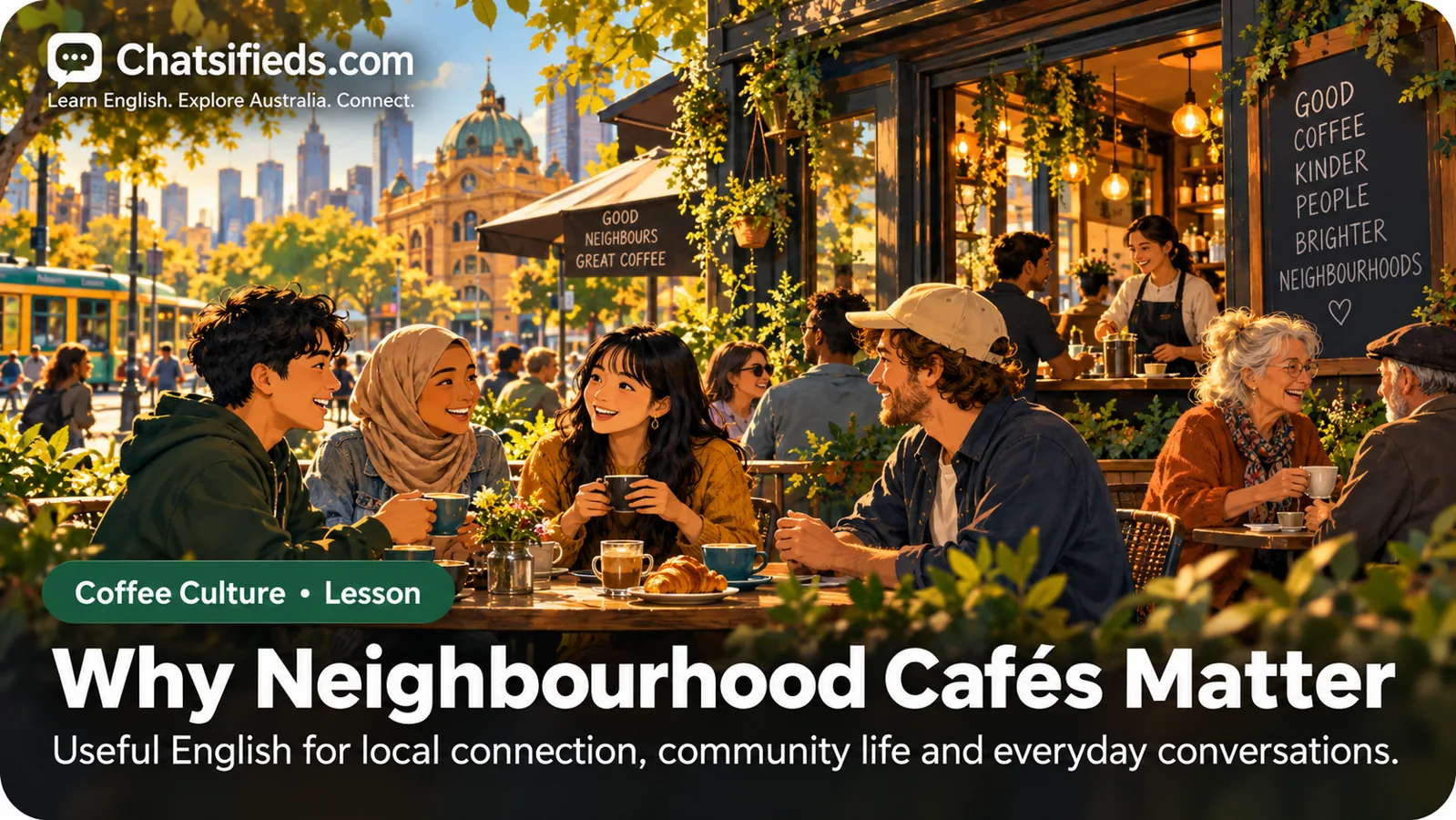
A neighbourhood café can be more than somewhere to buy a drink: a place to meet friends, pause in a working day or get to know local traders. But not every café is a social hub, and not everyone wants to chat. A greeting and a thank-you are enough, and you can build from there.
Understand the Australian context
State Library Victoria's coffee collection documents Melbourne's independent café tradition and its connection to local neighbourhood traders. Social research also explores how familiar meeting places can help people feel connected, while suggesting that the activity and relationships matter more than the place alone.
For newcomers, a café can be a manageable place to practise a short greeting or ask about a community notice. Respect other people's space: staff may be busy and customers may prefer privacy.
Belonging builds slowly and is not the goal for everyone. Some people enjoy a short chat each morning, while others prefer to read or sit quietly. Both are normal.
Key words and phrases
- neighbourhood
- The area where people live near each other.
- regular
- A customer who visits a place often.
- noticeboard
- A board where local notices are posted.
- community
- A group of people connected by place or interest.
- familiar face
- Someone people recognise.
- settle in
- Become comfortable in a new place.
- local event
- An event in your area.
- small talk
- Light, friendly conversation.
Conversation practice: becoming a familiar face
Staff: Morning! The usual?
Customer: Yes, please. Thanks for remembering. I have only been coming here for a few weeks.
Staff: No worries. Are you settling in okay?
Customer: Yes, I think so. I moved to the area last month.
Customer: Do you know if there are any local events this weekend?
Staff: There is a notice about a community market on the board near the door. It changes pretty often.
Customer: Great. Is it okay if I take a photo of the notice?
Staff: Sure, go for it.
Customer: Thanks. Sorry, I can see you are busy. I will let you get on with it.
Staff: You are all good. Let me know if you cannot find it.
Customer: Will do. Have a good day!
Staff: You too. See you tomorrow!
- "The usual?" shows the staff member recognises a regular.
- "Is it okay if I take a photo?" asks permission politely.
- The customer ends the chat politely when the staff member is busy.
More useful phrases
- Is there a community noticeboard around here?
- Where can I see local notices?Use it: Ask about local information.
- I am new to the area.
- I recently moved here.Use it: A friendly way to start.
- Do you know if there are any local events this weekend?
- Is anything happening nearby?Use it: Ask for local ideas.
- Is it okay if I put up a notice?
- May I post something here?Use it: Ask first.
- Is it okay if I take a photo of the notice?
- May I photograph it?Use it: Ask permission.
- Lovely day, is it not?
- The weather is nice.Use it: An easy small-talk line.
- I will let you get on with it.
- I will leave you to your work.Use it: End a chat politely.
- Sorry, could you say that again?
- Please repeat what you said.Use it: Use this when you miss a word.
- Thanks, have a good one.
- Thank you, and I hope your day goes well.Use it: A friendly way to finish a chat.
Say it in a real conversation
Use these sentences in a real conversation. The replies you hear will change from place to place.
| When | You can say | It means |
|---|---|---|
| Ask about local information. | Is there a community noticeboard around here? | Where can I see local notices? |
| A friendly way to start. | I am new to the area. | I recently moved here. |
| Ask for local ideas. | Do you know if there are any local events this weekend? | Is anything happening nearby? |
| Ask first. | Is it okay if I put up a notice? | May I post something here? |
| Ask permission. | Is it okay if I take a photo of the notice? | May I photograph it? |
| An easy small-talk line. | Lovely day, is it not? | The weather is nice. |
Listen for the key words in the reply and answer in a short, clear sentence.
Say it aloud: ask about local information
Saying a sentence out loud before you need it makes real conversations easier. Accents differ, so aim to be clear, not perfect.
- Slow. Read the sentence slowly, one phrase at a time.
- In full. Say: Is there a community noticeboard around here?
- At normal speed. Say it again, as you would in a real conversation.
- Listen. Listen for the key words in the reply.
Practice 1: Role-play with a partner
Situation: You moved to a new suburb last month. Chat briefly with café staff and ask about local events.
Work with a friend, a classmate or your mirror. One person is the staff. The other is customer. Read the lines, then cover the “You could say” answers and try it from memory. Swap roles.
staff: “Morning! The usual?”
You could say:
- “Yes, please. Thanks for remembering. I have only been coming here for a few weeks.”
- “Thanks, have a good one.”
staff: “No worries. Are you settling in okay?”
You could say:
- “Yes, I think so. I moved to the area last month.”
- “I am new to the area.”
staff: “There is a notice about a community market on the board near the door. It changes pretty often.”
You could say:
- “Great. Is it okay if I take a photo of the notice?”
- “Is it okay if I take a photo of the notice?”
staff: “Sure, go for it.”
You could say:
- “Thanks. Sorry, I can see you are busy. I will let you get on with it.”
- “I will let you get on with it.”
Challenge: Do the conversation again without looking at the lines, and change one detail.
Practice 2: Fill the gap
Say the missing word or phrase out loud before you open the answer.
Is there a community ___ around here?
Show answer
noticeboard — The phrase means: Where can I see local notices?
Do you know if there are any local events this ___?
Show answer
weekend — The phrase means: Is anything happening nearby?
Is it okay if I put up a ___?
Show answer
notice — The phrase means: May I post something here?
Is it okay if I take a photo of the ___?
Show answer
notice — The phrase means: May I photograph it?
The area where people live near each other. The word is ___.
Show answer
neighbourhood — "neighbourhood": The area where people live near each other.
A customer who visits a place often. The word is ___.
Show answer
regular — "regular": A customer who visits a place often.
Common mistakes and better ways to say it
Less helpful: “Where do you live? Are you married?”
Try instead: “Have you always worked in this area?”
Personal questions can feel intrusive. Ask about the place instead.
Less helpful: “Every café is a social hub.”
Try instead: “Some people want a quiet visit.”
Respect privacy and read the situation.
Less helpful: “Starting a long story when the café is busy.”
Try instead: “Keep it short and say thanks.”
Staff may be busy.
Less helpful: “Posting a notice without asking.”
Try instead: “Is it okay if I put up a notice?”
Each café has its own rules.
Belonging builds slowly
A smile, a greeting and a thank-you are a good start. Over time staff may remember your name or order, but you never need to share personal details. A noticeboard or the local library can be a gentle way to find groups and events.
Not everyone feels equally welcome everywhere, so notice how a place feels and choose the cafés and routines that suit you.
Advertisement
Real-life mission
Try a small local connection.
You do not need to buy anything. Saying the sentences aloud is good practice.
Phrase Wall practice: phrases to own
Open a phrase to see it on the Phrase Wall, practise it, and save it to My Learning.
- “I am new to the area.”I recently moved here.
- “Is there a community noticeboard around here?”Where can I see local notices?
- “Do you know if there are any local events this weekend?”Is anything happening nearby?